
Tiny Desk AI Videos: Where the Trend Came From and How to Make Your Own
Where the Tiny Desk AI trend came from, why every version edits the same 19 seconds of an NPR concert, an honest workflow for making your own from a photo, and a simpler alternative.
Tiny Desk AI Videos: Where the Trend Came From and How to Make Your Own
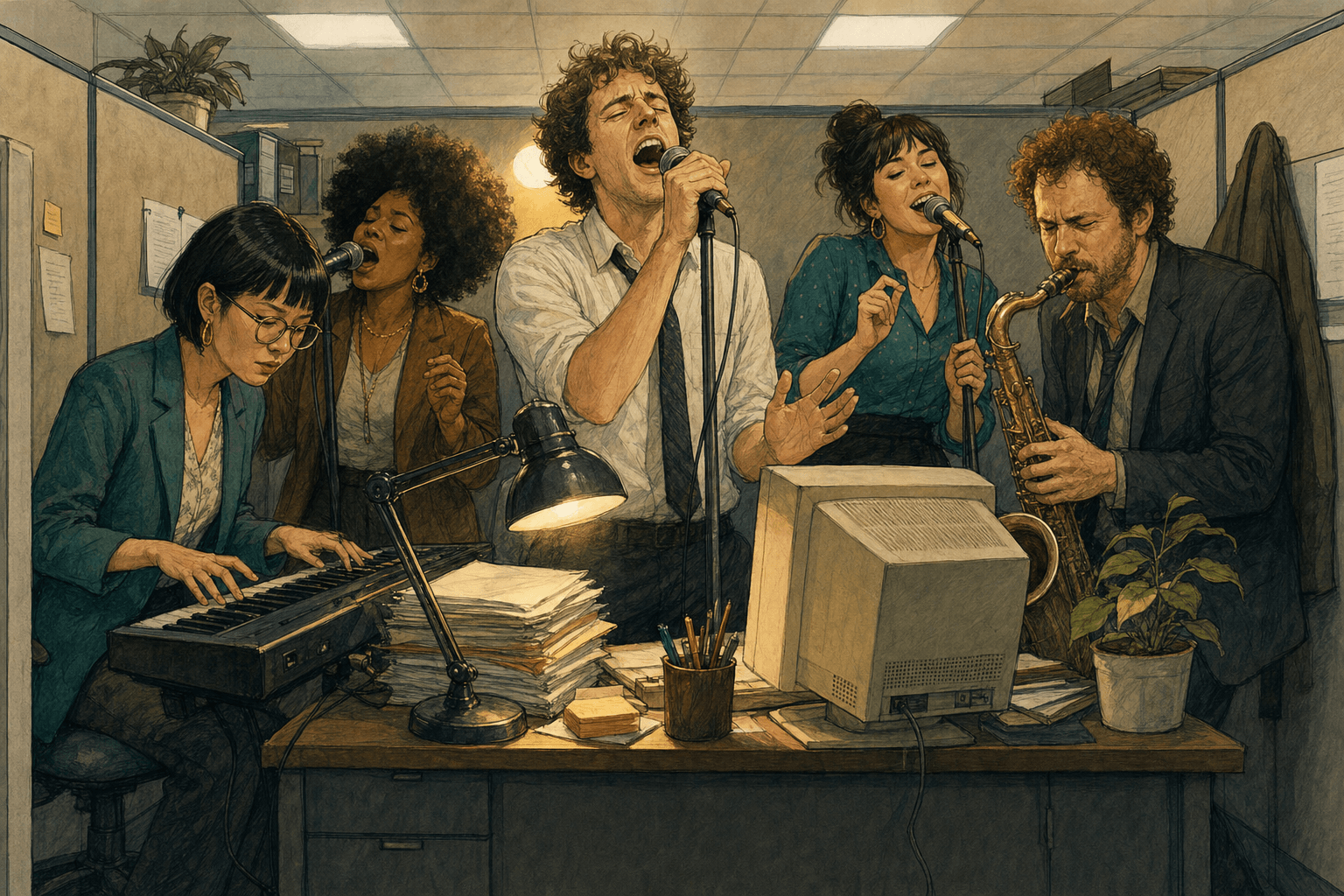
You have probably seen one by now: a band crammed behind a small desk in a tiny office, except every musician's face belongs to someone who was never there — college football coaches, a friend, your boss. These "Tiny Desk AI" videos went viral in late October 2026, racking up millions of views within days, and they all remix the same 19 seconds of an NPR concert. This article explains where the trend came from, why every version edits that same clip, what it actually takes to put your own face in one, and the simpler route if you would rather generate your own AI performance video from a single photo.
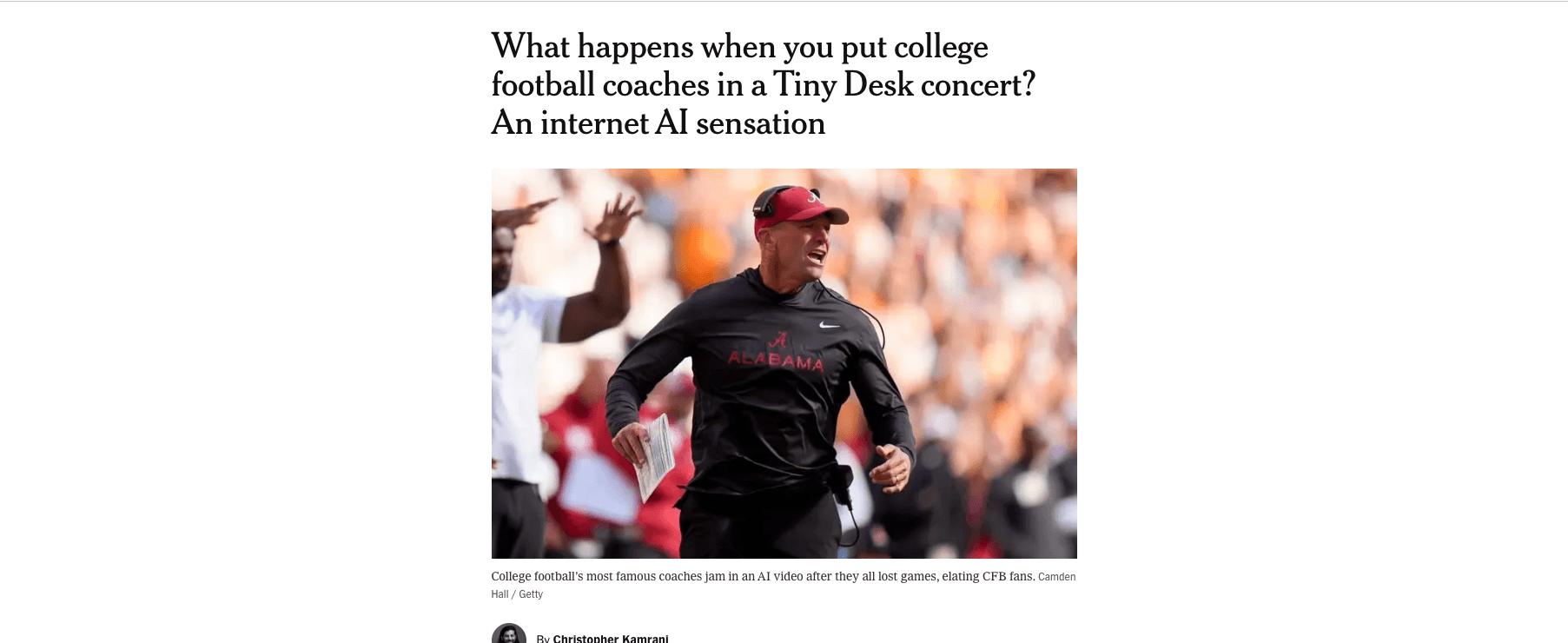
Source: The New York Times / The Athletic, “What happens when you put college football coaches in a Tiny Desk concert?”, October 23, 2026.
What the Tiny Desk AI trend actually is
NPR's Tiny Desk Concerts is a live music series the network has filmed since 2008 behind a desk at its Washington, D.C. headquarters — around 1,800 concerts and counting. The AI trend borrows one specific performance: in June 2023, R&B legend Charlie Wilson closed his Tiny Desk concert with The Gap Band's 1982 hit "Outstanding," which had already become a meme anthem for "washed" athletes and past-their-prime celebrities.
The video that started the trend posted on October 18, 2026. A 23-year-old Alabama fan who runs the burner account @theburnerfromhe11 waited out a chaotic Saturday — for the first time in regular-season history, five of the top seven ranked teams (Texas, Indiana, Georgia, Alabama, and Notre Dame) all lost on the same day — then put the weekend's losing coaches into the band. Alabama's Kalen DeBoer took lead vocals, Texas's Steve Sarkisian and Indiana's Curt Cignetti sang backup, Georgia's Kirby Smart shook a tambourine, and Notre Dame's Marcus Freeman played sax. The creator told The Athletic he built it on the Higgsfield AI platform using motion-transfer models.
Within days the clip had more than 2 million views on TikTok, 2 million on Instagram, and up to 6 million impressions on X (figures the creator reported). Snoop Dogg reshared it. Even Tiny Desk producer Alanté Serene joked in the comments about "calling our legal team." Once one format reliably gets that reaction, copies are inevitable — a Dallas Cowboys legends version followed, and TikTok now refers to the whole format as the "outstanding tiny desk" set.
Why every version edits the same 19 seconds
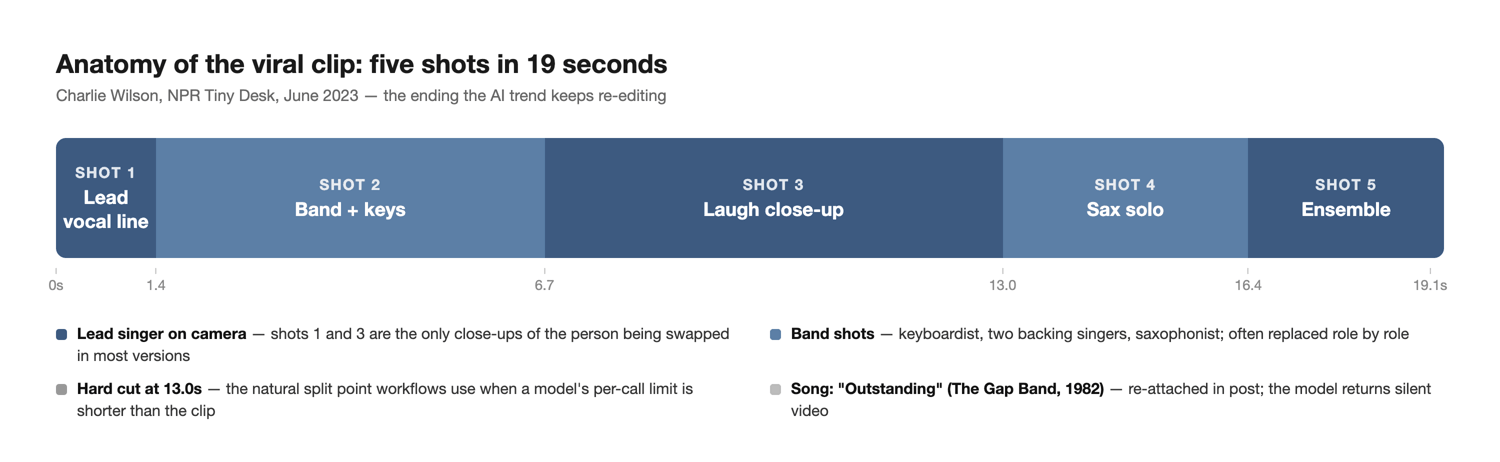
The meme clip is the final stretch of Charlie Wilson's performance — roughly 19 seconds, starting near the 23:46 mark of NPR's video — and it has a fixed five-shot structure: the lead singer's opening line (0–1.4s), the band behind the keyboard (1.4–6.7s), a big laugh close-up (6.7–13s), a sax solo (13–16.4s), and a final ensemble shot (16.4–19.1s).
That structure is why nobody regenerates the scene from a blank prompt. The whole appeal is recognizing the real clip — the room, the cuts, the timing — with new faces dropped in. If you generate a lookalike scene from scratch, you lose the thing that makes people stop scrolling. And because the original song has to line up with the visible performance, practitioners keep the viral clip as a reference video and let an AI video-edit model replace the people in it, shot by shot.
How to make your own Tiny Desk AI video
This workflow is documentation-based: it comes from The Athletic's interview with the original creator and two detailed public write-ups of test renders and tool pipelines published in late October 2026. Nobody's output is identical, and you should treat the specifics as reported practice, not guaranteed results.
What you need:
- a vertical copy of the ~19-second reference clip;
- one clear, front-facing portrait photo per person you want to insert (with their permission);
- a video model that supports reference-driven editing — accepting a reference video plus image references — rather than plain text-to-video;
- a video editor for the final audio pass.
The workflow:
- Prepare the portrait. Use a well-lit photo where the face is easy to see; dark crops, sunglasses, and group shots produce worse swaps. Confirm you have permission to depict the person.
- Set up the reference. The model needs the clip as its motion and framing reference, plus your portrait as the identity reference for the role you are replacing.
- Prompt for preservation, not performance. The documented prompt pattern is short: name the person being replaced, describe them as they look in the photo, and tell the model to keep everything else the same — motion, expressions, camera, background.
- Replace one person per role. In the documented tests, assigning the same photo set to two roles (say, lead singer and keyboardist) swapped nobody, while one face per role swapped cleanly.
- Face-check the output. A failed swap still returns a success status. Check that the original person is actually gone before you share anything.
- Put the song back. The model returns silent video; the "Outstanding" track is re-attached in post. Export a silent copy too, because platforms may mute the commercial recording.
The gotchas that actually matter:
- Never mention the mouth. In one team's 32 documented test renders, any prompt line about lip-sync made the mouth move constantly — including during parts where the singer just grins. Omitting the mouth entirely tracked the reference best.
- Odd-length references get mangled. Edit mode wants whole-second clips of at least 4 seconds; off-length references came back truncated or padded, which is why careful workflows split the 19-second clip at the 13-second hard cut and stitch it afterward.
- Lip sync is not word-perfect. Even with the soundtrack as an audio reference, a face can look plausible while missing syllables. Expect "close enough," not exact.
- A swap is one generation per attempt. Budget for several tries; the documented pipelines regenerated individual shots repeatedly before the band was clean.
The rights and brand realities
Three things are worth knowing before you post. First, Tiny Desk is an NPR program brand, and the third-party "Tiny Desk AI" tools that appeared within days of the trend all carry explicit disclaimers that they are independent parody tools, not affiliated with NPR or Tiny Desk Concerts. NPR's own producer reacted to the coaches video with a joke about lawyers — treat the brand line as real. Second, the audio is a licensed live recording, not a free sound; that is exactly why platforms mute some versions, and why experienced creators export a silent copy and re-add audio inside the app. Third, only use photos of people who agreed to be depicted — a convincing swap of a real person without consent is the fastest way to turn a joke into a problem.
The simpler route: generate your own AI performance video
Everything above gets you that clip. If what you actually want is your own AI performance video — you at a microphone, your friends as the band — you do not need the NPR footage at all. An image-to-video generator takes one portrait and a prompt, and produces an original performance scene in the style you describe: the stage, the lighting, the instruments, the camera moves. You trade the meme's exact recognizability for full control of the concept, no reference-clip hunting, and no ffmpeg audio surgery.
AI Fruit works exactly this way. You pick a video model, upload your photo, describe the performance scene, and see the settings and credit cost before you generate — models like Seedance 2.0 even accept reference images to guide how each person should look across shots.
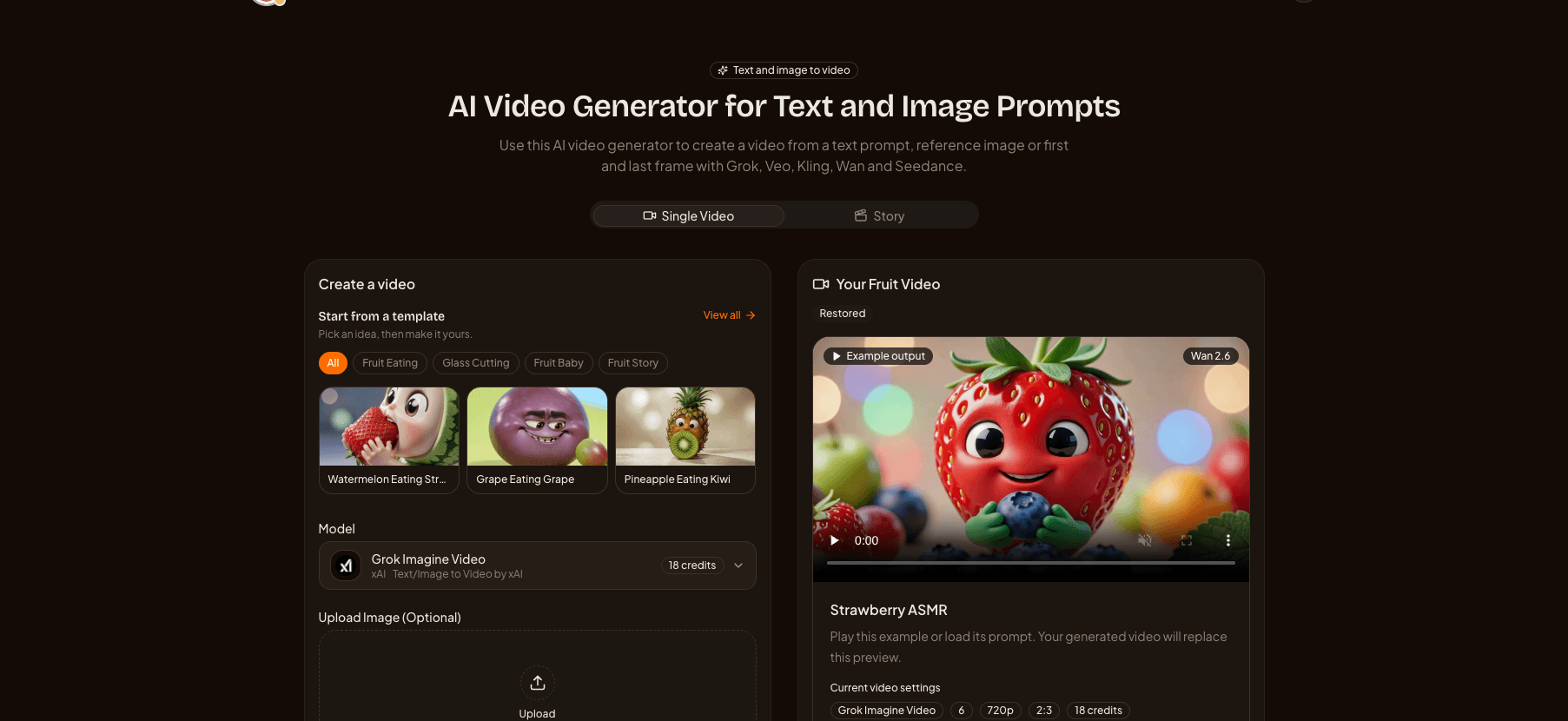
Want your own version without the DIY pipeline? Generate an AI video from your photo in AI Fruit — your original creation, no editing timeline required.
AI Fruit is an independent tool and is not affiliated with NPR or Tiny Desk Concerts. This article describes the trend for editorial purposes; Tiny Desk is a program name of NPR.
FAQ
Which AI model makes the Tiny Desk video? The documented pipelines use reference-driven editing models — the original creator cited Higgsfield AI with motion transfer, and public test write-ups used ByteDance's Seedance models in video-edit mode. Any model that accepts a reference video plus image references can, in principle, do the swap; results vary by model and settings.
Does the AI video lip-sync the words exactly? No. Even with the song fed in as an audio reference, the mouth can miss syllables or keep moving between lines. The documented fix is to leave the mouth out of the prompt entirely and accept "close enough."
Can I post it without the audio getting muted? Sometimes. The song is a licensed NPR recording, so platforms may mute it. Creators commonly export a silent version and add the trending sound inside TikTok or Instagram instead.