
Seedance 2.5: 30-Second Video, Multimodal References, and Targeted Editing
A practical Seedance 2.5 overview covering 30-second generation, multimodal references, targeted editing, current access, and evidence limits.

Seedance 2.5 is ByteDance Seed's new audio-video generation model, officially announced on July 31, 2026. Its practical headline is a larger control surface: up to 30 seconds in one pass, up to 30 image, 10 video, and 10 audio references in one request, and timestamp-level plus targeted editing. Those capabilities are documented in ByteDance's launch announcement and model page.
For creators, the useful shift is from describing a short moment to planning a sequence. A 30-second request needs story beats; a larger reference set needs explicit roles; and a targeted edit needs a precise time range, one requested change, and a list of elements to preserve.
Seedance 2.5 facts at a glance
| Question | What the primary sources say | Evidence status |
|---|---|---|
| How long can one generation be? | Up to 30 seconds in a single pass. | Officially documented |
| Can a clip be extended? | The model page says a generated video can be extended twice. | Officially documented |
| How many references can one request use? | Up to 30 images, 10 video clips, and 10 audio clips. | Officially documented |
| What editing controls are described? | Timestamp-level direction and targeted editing, plus green-screen, camera-perspective, and reference-based editing. | Officially documented, not independently tested here |
| Where was it available at launch? | On July 31, ByteDance said it was rolling out to Jimeng AI and Doubao Pro; BytePlus ModelArk API access was described as coming soon. | Announcement-time status, not universal current availability |
| What remains uncertain? | Independent quality, speed, cost, API readiness, regional access, commercial-use terms, and reliability under difficult inputs. | Not established by this research |
What actually changed in Seedance 2.5?
The practical change is not simply “twice as many seconds.” A 30-second generation creates enough room for setup, development, and resolution inside one request. ByteDance's announcement explicitly frames this as a move from a short clip toward a more complete story, and says the new limit extends the prior 15-second single-pass window to 30 seconds.
That changes the creator's job. A one-line prompt may be enough for a five-second visual gag, but it is a weak production plan for several connected shots. For longer output, the prompt needs a beat map: what happens first, where the turning point occurs, how the camera moves, when audio changes, and what the final frame resolves.
The second shift is the reference budget. According to the official announcement, one request can accept as many as 30 images, 10 videos, and 10 audio clips. The useful takeaway is not “attach everything.” It is to assign a clear role to every reference—character identity, product shape, location, camera language, motion, voice, ambience, or pacing. Conflicting references can still produce conflicting instructions.
The third shift is edit scope. ByteDance describes timestamp-level control during generation and targeted changes after generation, alongside green-screen, camera-perspective, and reference-based editing. If those controls behave as described, creators can ask for a change in one time span instead of rewriting the entire piece. That is a workflow hypothesis worth testing; it is not a result established by the launch material.
How should creators plan a 30-second Seedance 2.5 prompt?
Start with a timeline, not adjectives. A practical planning document can be short, but it should make four decisions explicit.
1. Write a beat map
Divide the story into a few time ranges. Give each range one narrative purpose and one camera instruction. For example:
- 0–5 seconds: establish the fruit character, location, and visual rule.
- 5–12 seconds: introduce the action and first camera move.
- 12–22 seconds: create the change, conflict, or transformation.
- 22–30 seconds: resolve the action and hold a usable final composition.
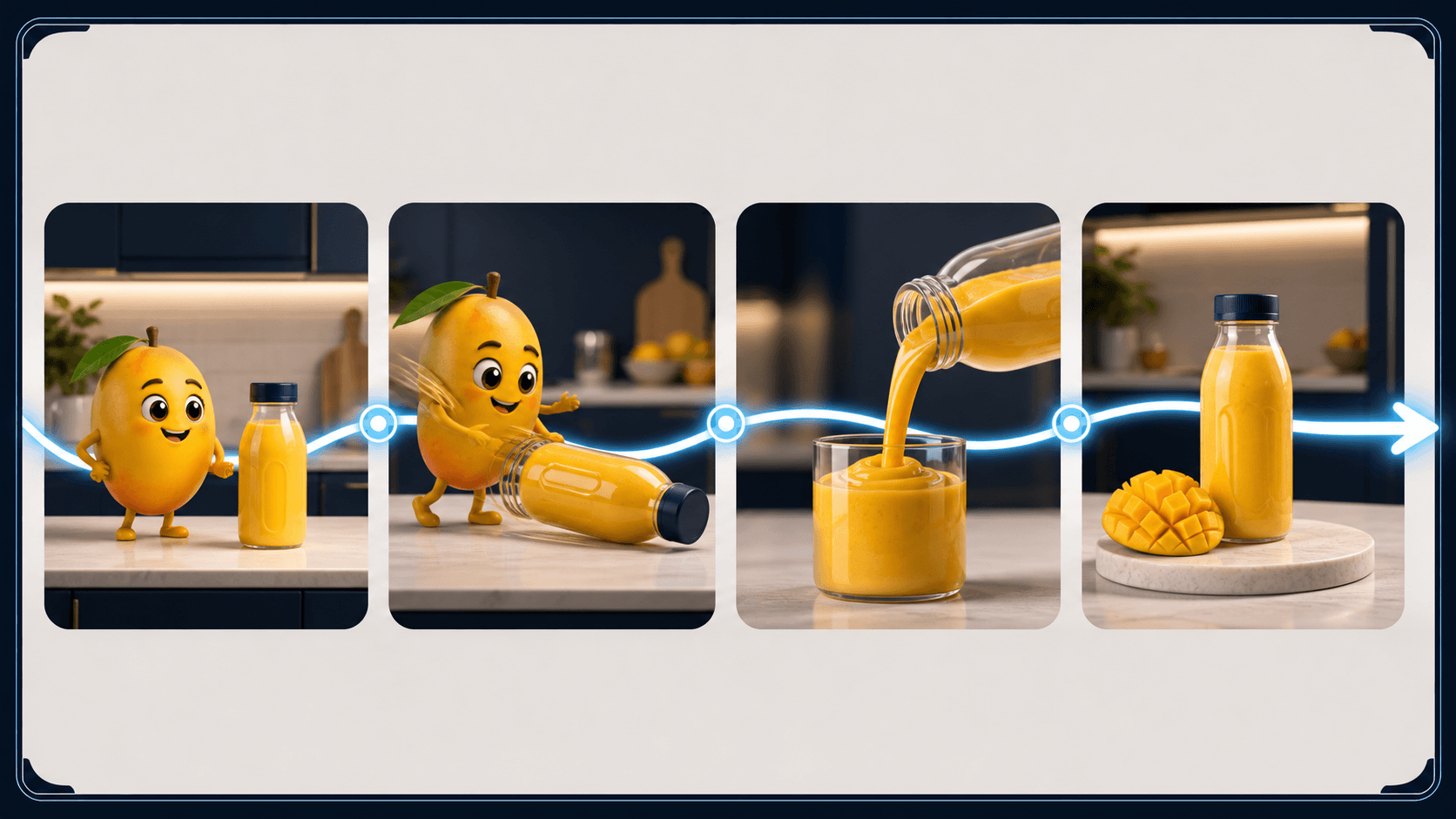
A conceptual 30-second beat map for planning, not a Seedance 2.5 output.
These time ranges are a planning technique, not a promise that the model will obey every boundary. A useful test should measure where timing drifts and whether a later edit stays local.
2. Give each reference one job
Create a reference map before attaching files:
@Image 1: main character design@Image 2: packaging and label shape@Video 1: camera motion only@Audio 1: rhythm and ambience
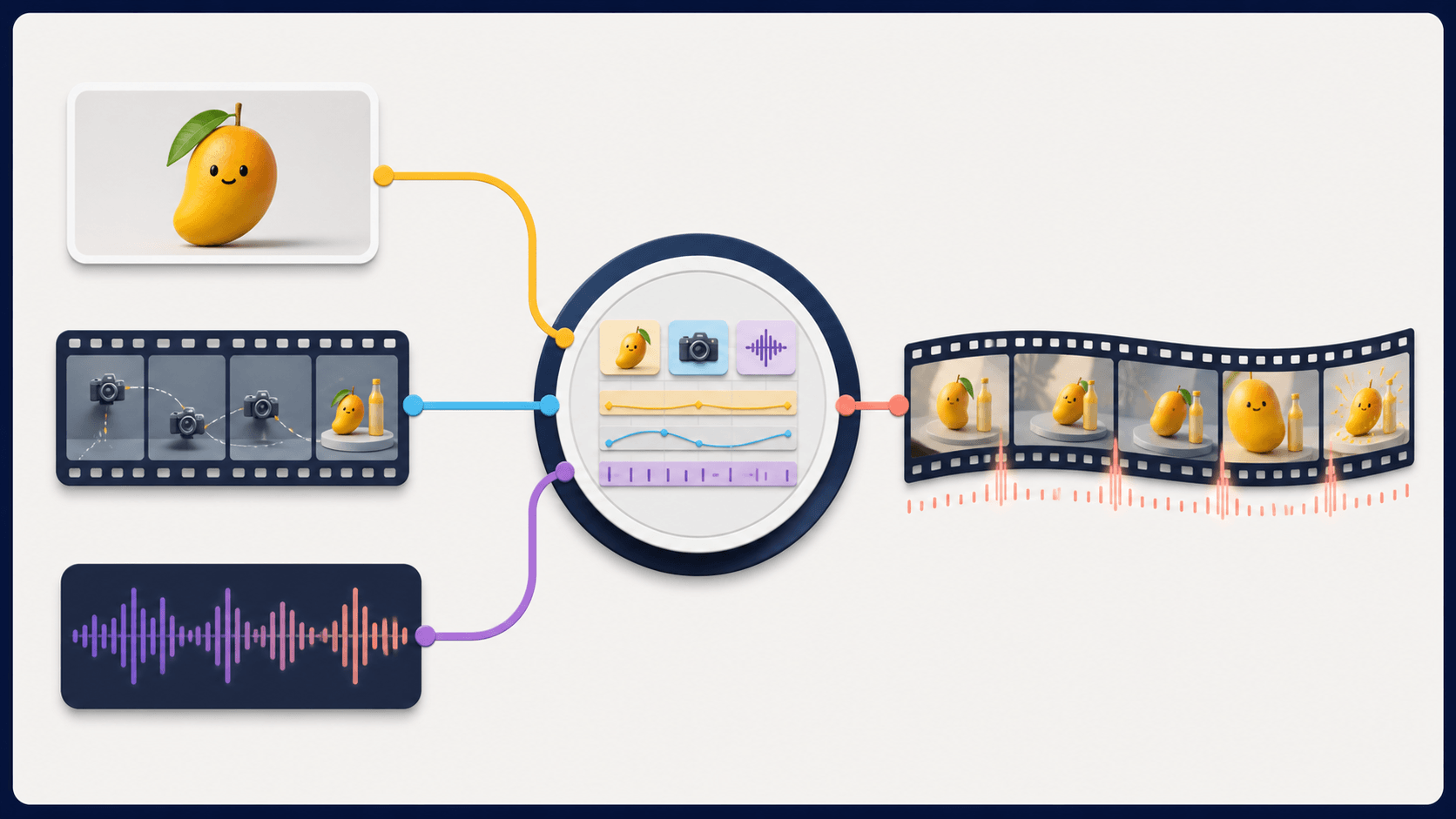
A conceptual reference-role map; it does not show a tested Seedance 2.5 workflow.
Then say which attributes should transfer and which should not. “Use the framing and camera speed from @Video 1, but not its subject or color palette” is clearer than “make it like this video.” More references should add control, not ambiguity.
3. Scope edits by time and property
An edit request should identify the time span, the property to change, and the elements to preserve. For example: “From 12–16 seconds, change only the camera from a static medium shot to a slow orbit. Keep the fruit character, packaging, lighting, dialogue, and action unchanged.”
That wording makes the result easier to evaluate. Reviewers can check whether the requested camera change occurred and whether unrelated elements drifted.
4. Define failure checks before generation
Decide what “good” means before seeing the output. For a longer fruit product story, a useful checklist might include:
- character and package identity across cuts;
- legible label shape without inventing text;
- action and audio alignment;
- physical plausibility during contact, pouring, slicing, or splashing;
- continuity before and after a targeted edit;
- a final frame that works for the intended aspect ratio.
ByteDance itself acknowledges that complex-motion physics and scenes with many interacting subjects still have room for improvement. Those are therefore sensible test priorities.
Where can you access Seedance 2.5?
Access needs a date stamp. In its July 31, 2026 announcement, ByteDance said Seedance 2.5 was rolling out to Jimeng AI and Doubao Pro, while BytePlus ModelArk API access was “coming soon.” That launch-time statement does not establish access for every region, account, or developer today.
Before planning production around the model, verify the exact surface available to your account, the current model name, input limits, price, retention policy, output terms, and API lifecycle. Those details should not be inferred from a third-party comparison or a different Seedance version.
What Seedance 2.5 changes—and what still needs testing
Thirty-second generation changes prompt writing into sequence planning. Multimodal references make asset roles and conflict management more important. Targeted editing makes time ranges and preserved attributes part of the edit brief.
Independent testing is still needed to establish timing and identity stability, physical plausibility, prompt adherence, edit spillover, retries, latency, cost, current API and regional access, and applicable usage terms. The official sources document the intended capabilities and launch-time access statements; they do not settle those operational questions.
Ready to create your next fruit video?
Explore the AI video models currently available on AI Fruit, review the settings and credit estimate, and start when you're ready.