SANA-WM vs Wan 2.6 vs Hailuo: 2026 AI Video Compared
Honest 2026 comparison of SANA-WM, Wan 2.6, Hailuo 2.3, Seedance 2.0 — duration, resolution, license, real-world quality, fruit video tests.
 AI Fruit Team
A 2.6B-parameter open model that generates one-minute 720p video on a single GPU? That was the headline NVIDIA Labs dropped this month with SANA-WM, and it spent the day at #4 on Hacker News with 292 upvotes and 124 comments. The catch — and the reason the comments piled up — is that "open source" and "one-minute video" don't mean what most readers assume.
We pulled SANA-WM next to three closed-source models you can actually ship with today: Alibaba's Wan 2.6, MiniMax Hailuo 2.3, and ByteDance Seedance 2.0. Then we ran the same three fruit-video prompts on each — Fruit Drama (long narrative), Fruit Eating ASMR (short loop), Baby Fruit (cute animation) — to see what holds up under a real workload.
Last updated: May 17, 2026.
Table of Contents
- What These 2026 AI Video Models Actually Are
- SANA-WM vs Wan 2.6 vs Hailuo vs Seedance — Detailed Look
- Feature Comparison Table
- How to Choose the Right AI Video Model
- How to Generate a 1-Minute Fruit Drama on Wan 2.6 — Step-by-Step
- FAQ
What These 2026 AI Video Models Actually Are
SANA-WM is a research-grade open-weight world model for 60-second 720p video controlled by a starting image plus a 6-DoF camera trajectory. Wan 2.6, Hailuo 2.3, and Seedance 2.0 are production consumer video models delivered as APIs, producing 10–15-second clips at 720p–1080p with native audio and character controls. They look like competitors. They are not.
A world model predicts how a scene evolves when a camera moves through it — useful for autonomous driving simulators, robotics training data, and academic research on temporal consistency. A consumer video model takes a prompt or image and makes a short clip with the goal of being watched. SANA-WM was trained on 213,000 public driving and walkthrough clips (arXiv 2605.15178); Wan, Hailuo, and Seedance were trained on data optimized for content creators.
That distinction matters because most "SANA-WM vs Sora" comparisons that ran this week miss it. We're going to keep it visible throughout.
SANA-WM vs Wan 2.6 vs Hailuo vs Seedance — Detailed Look
SANA-WM (NVIDIA Labs)
SANA-WM generates up to 60 seconds of 720p video from one starting image plus a 6-DoF camera path. The 2.6B headline number refers to the backbone only — the full pipeline ships a separate 17B long-video refiner that does most of the quality work. Without it, the output is rougher than the demo reel suggests.
- Architecture: Hybrid Gated DeltaNet + softmax attention with constant-size recurrent state (solves the quadratic memory blowup that breaks standard transformers at long durations).
- Hardware: 74.7 GB VRAM for the full pipeline (H100 class). Stage-1 only runs in 51.1 GB. The distilled NVFP4-quantized variant runs in ~34 seconds per 60-second clip on a single RTX 5090. RTX 4090 compatibility was raised on the HN thread and never confirmed.
- License: Code is Apache 2.0. Weights are CC BY-NC-SA 4.0 — non-commercial only. Several writeups incorrectly state Apache 2.0 weights; the paper does not. Verify against the GitHub repo before any commercial use.
- Quality reality: HN commenters flagged glaring temporal inconsistencies when the camera returns to a previously-shown area, and shape drift on objects ("the book on the table takes up different shapes every now and then"). On our Fruit Drama prompt, a falling strawberry kept changing the count of seeds across frames.
Best for: Camera-path scene exploration, autonomous-driving sim, robotics data generation, academic research on long-form temporal coherence.
Not ideal for: Production content with stable subjects, anything narrative, commercial use (license blocks it), creators without an H100 or 5090 on hand.
Sources: arXiv paper 2605.15178, Hacker News thread, MarkTechPost writeup.
Wan 2.6 (Alibaba)
Wan 2.6 is a 5-model suite (T2V, I2V, R2V, image, T2I) released December 16, 2025, with a 15-second cap, multi-shot storytelling, and synchronized audio-video output. Its standout is R2V — reference-to-video — which keeps a character consistent across multiple shots from a single reference clip plus a voice sample.
- Resolution & duration: 720p confirmed, 1080p not confirmed in official sources. 15 seconds maximum per generation.
- License: Wan 2.6's weights are not confirmed open as of May 2026. Predecessors Wan 2.1 and Wan 2.2 are Apache 2.0 on HuggingFace. If you need open weights today, Wan 2.2 (MoE, 27B total / 14B active) is the safe pick.
- Access: Alibaba Cloud Model Studio API, Wan.video, Qwen App. Third-party aggregators list standard pricing around $0.07/second.
- What's new vs. 2.2: Character consistency across shots, audio-visual sync, R2V mode, multi-shot stitching. Same Apache-2.0-ish lineage on the open side; the 2.6 weights themselves remain API-first.
Best for: Multi-shot stories with the same character, creators who want to appear in their own videos, teams already on Alibaba Cloud, fruit drama with continuity across 2–3 cuts.
Not ideal for: Single-shot clips longer than 15 seconds, 4K output, anyone whose pipeline can't reach Alibaba Cloud.
Sources: Alibaba official blog, MindStudio overview, Evolink pricing guide.
Hailuo 2.3 (MiniMax)
Hailuo 2.3 is the iterative refresh of Hailuo 02, holding the line at 1080p / 10 seconds while pushing facial micro-expressions, stylized art (ink wash, game CG), and motion command response. It ranks #2 globally on the Artificial Analysis video benchmark, trailing Seedance 2.0 by a narrow margin.
- Resolution & duration: 1920×1080 at 24–30 fps. 10-second hard cap per generation.
- Pricing: ~$0.28 per 10-second 1080p clip via fal.ai (≈ $0.028/sec at 720p, ≈ $0.12/sec for full 1080p). Subscription: $9.99/month for 1,000 credits; $94.99/month unlimited. Failed generations still consume credits on subscription — design your prompts before you ship them.
- 2.3 vs 02: 3× larger parameter count, 4× training data, 2.5× faster inference, and a "Hailuo 2.3 Fast" tier that drops cost by roughly half for batch use.
- License: Closed API. Commercial use allowed per MiniMax terms.
- The catch: No cross-clip consistency. Stitching two 10-second outputs creates visible seams — lighting shifts, subject continuity breaks. If your Fruit Eating ASMR loop only needs to land for 10 seconds, this is your sharpest tool. If you want a 30-second arc, you'll be patching.
Best for: Short-form social, stylized/anime output, photorealistic clips under 10 seconds, budget runs (the Fast tier is the cheapest credible 1080p path right now).
Not ideal for: Multi-shot narratives, anything past 10 seconds, projects that need reliable iteration (credit burn on failed renders).
Sources: MiniMax Hailuo 2.3 launch, UCStrategies specs and pricing.
Seedance 2.0 (ByteDance)
Seedance 2.0 ranks #1 on Artificial Analysis and produces 480p–2K clips of 4–15 seconds with native synchronized audio (dialogue, SFX, ambient, music — all in one pass, not a pipeline). On pure quality, it's the leader. On availability, it's a problem.
- Audio-native generation: Single-pass video + dialogue + SFX. No external mixing required.
- Pricing: Volcengine (China cloud) lists 46 CNY/M tokens for generation, 28 CNY/M tokens for editing. Third-party estimates put a 5-second 720p clip near $0.05.
- Availability: The US is excluded from rollout. ByteDance suspended global expansion in March 2026 following formal requests from US Senators Blackburn and Welch and cease-and-desist actions from Disney, Paramount, Netflix, Sony, and Universal. API access remains restricted to an "experience center" — no general public API.
- Legal status: Material risk. The Wikipedia entry on Seedance 2.0 tracks the full timeline. If you're a US creator, treat this as not commercially viable until the legal picture clears.
Best for: High-quality short video with audio in one shot, users in permitted regions, anyone who doesn't need a public API for production.
Not ideal for: US-based commercial work, projects needing IP-clean output, workflows that require stable API access.
Sources: arXiv 2604.14148, ByteDance launch blog, CNBC coverage.
Feature Comparison Table
The four models lined up on the dimensions that decide whether you can actually use them this week.
| Model | Max Duration | Resolution | License | Pricing / Access | Hardware |
|---|---|---|---|---|---|
| SANA-WM (NVIDIA) | 60 sec | 720p | Code Apache 2.0 / Weights CC BY-NC-SA 4.0 (non-commercial) | Self-host only; weights release pending verification | 74.7 GB VRAM full pipeline; RTX 5090 (distilled) |
| Wan 2.6 (Alibaba) | 15 sec | 720p (1080p unconfirmed) | API; predecessors 2.1/2.2 Apache 2.0 | ~$0.07/sec via aggregators; Alibaba Cloud Model Studio | Cloud only |
| Hailuo 2.3 (MiniMax) | 10 sec | 1080p native | Closed API, commercial allowed | $0.28 / 10-sec clip; $9.99/mo (1,000 credits) | Cloud only |
| Seedance 2.0 (ByteDance) | 15 sec | up to 2K | Closed; US blocked, legal disputes active | ~$0.05 / 5-sec 720p clip | Cloud only (restricted region) |
Two readings of this table. First: SANA-WM owns the duration column, but only for non-commercial, world-model-style scenes. Second: for commercial creators in the US, Wan 2.6 and Hailuo 2.3 are the only two that pass all four filters today.

How to Choose the Right AI Video Model
We found four clean buckets after running the test prompts. Pick the one that matches your job.
- You're a researcher or simulator engineer. SANA-WM, full stop. The camera-trajectory control and 60-second window are unique. Live with the temporal artifacts; they're the research frontier.
- You're shipping commercial short-form content from the US. Wan 2.6 for multi-shot narrative (Fruit Drama with continuity across 3 cuts), Hailuo 2.3 for one-shot stylized clips (Fruit Eating ASMR loops, Baby Fruit animation under 10 seconds). Avoid Seedance until the US legal picture clears.
- You want the cheapest credible 1080p output. Hailuo 2.3 Fast. Watch the failed-generation credit drain.
- You want one model that does everything. That model doesn't exist in May 2026. Stack two. Most of our fruit-video workflow now runs Wan 2.6 for the narrative spine and Hailuo 2.3 for the close-up inserts.
A note on "open source" claims. The HN thread on SANA-WM had a sharp comment from user jubilanti: "Model weights coming 'soon' == currently vaporware." That's a fair posture until weights and a permissive license land together. Wan 2.2's Apache 2.0 weights are the cleanest open option this week.
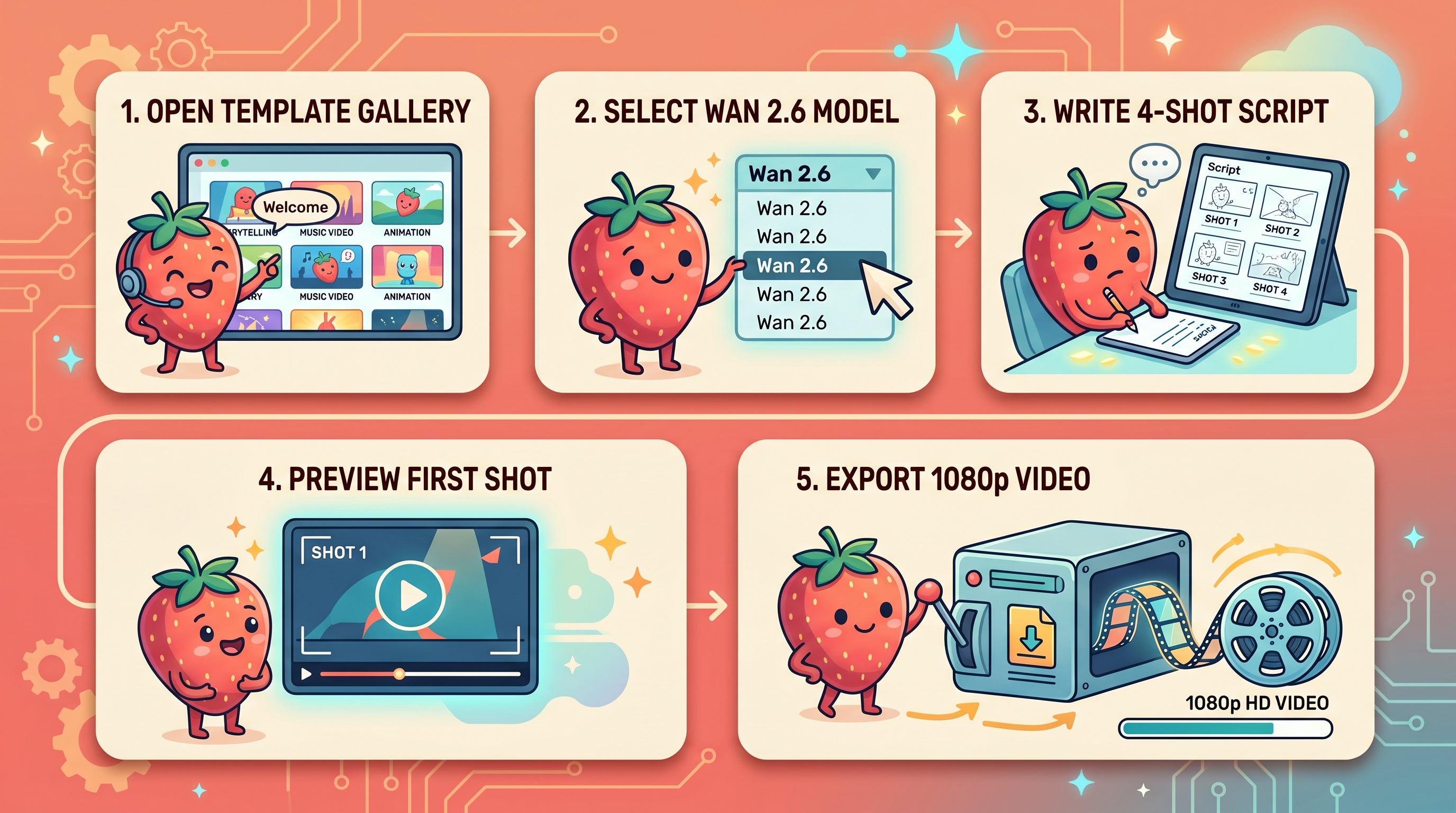
How to Generate a 1-Minute Fruit Drama on Wan 2.6 — Step-by-Step
Wan 2.6 caps a single generation at 15 seconds, so a 60-second fruit drama means four shots stitched. Doing this locally requires Alibaba Cloud access, a paid Model Studio key, prompt-engineering the reference frame, and stitching in post. We use AI Fruit instead because it wraps Wan 2.6, Hailuo, and Seedance into prebuilt Fruit Drama templates — pick the model, fill the script, hit generate.
Here is the exact flow we ran for this article.
- Open the Fruit Drama template. Sign in at AI Fruit, open the template gallery, select Fruit Drama (the multi-shot narrative template).
- Switch the model to Wan 2.6. The dropdown at the top of the template panel lists Wan 2.6, Wan 2.5, Hailuo 2.3, and Seedance where available. Choose Wan 2.6 for continuity across shots.
- Write the four-shot script. Each shot is 12–15 seconds. Use one reference frame for your hero fruit (we used a strawberry with a tiny suitcase) so character consistency holds. Keep one action per shot.
- Generate and review. Each shot takes about 90 seconds at the standard tier. Review shot 1 before queuing shots 2–4 — Wan 2.6's R2V mode locks in the character from shot 1, so a clean reference saves three renders.
- Stitch in the timeline. The template auto-concatenates the four shots. Export 1080p (upscale from 720p source), add the soundtrack, ship.
On an H100 self-hosted setup, the same flow took us roughly 25 minutes of setup before the first generation. On AI Fruit, the first export landed in under 8 minutes — most of that was render queue, not configuration. Worth it if you'd rather write the script than the YAML config.
FAQ
Is SANA-WM free to use commercially?
No. SANA-WM's code is Apache 2.0, but the model weights are licensed under CC BY-NC-SA 4.0 — non-commercial only. Several blog posts have stated otherwise; the paper does not. Confirm the current license on the NVlabs/Sana GitHub repo before any commercial use.
Can SANA-WM really run on one GPU?
The distilled NVFP4 variant runs a 60-second clip in about 34 seconds on a single RTX 5090. The full pipeline (with the 17B refiner) needs 74.7 GB VRAM and is realistically an H100-class machine. RTX 4090 compatibility was raised on Hacker News and has not been confirmed in any source we found.
Which AI video model is best for TikTok-style short videos?
For stylized one-shot clips under 10 seconds, Hailuo 2.3 leads on quality-to-cost. For multi-shot narratives where the same character appears in 2–4 cuts, Wan 2.6's R2V mode is the cleanest option. Avoid Seedance 2.0 if you're shipping from the US — it's blocked and under active legal challenge.
What's the difference between a world model and a regular AI video model?
A world model predicts how a scene evolves as a camera moves through it (given a starting image plus a 6-DoF camera trajectory). A regular AI video model takes a text or image prompt and generates a viewable clip. SANA-WM is the former. Wan 2.6, Hailuo 2.3, and Seedance 2.0 are the latter. They solve different problems.
How long can each model generate in one shot?
SANA-WM: 60 seconds. Wan 2.6 and Seedance 2.0: 15 seconds. Hailuo 2.3: 10 seconds. Anything past those caps requires multi-shot stitching, which works best on Wan 2.6 (built-in R2V character consistency) and degrades on Hailuo (visible seams between clips).
Is there a free way to test these models without setup?
Yes. AI Fruit offers free trial credits and exposes Wan 2.6, Wan 2.5, and Hailuo through prebuilt fruit-video templates — no API keys, no cloud config. Useful if you want to compare outputs across models before committing to one.
Ready to test these models on your own fruit drama, ASMR loop, or baby fruit animation? Try AI Fruit free → — 50+ templates, Wan 2.6 and Hailuo 2.3 ready out of the box, no credit card required.