Happyhorse 1.0 vs Seedance 2.0: Best AI Video Model 2026
Side-by-side test of Happyhorse 1.0 vs Seedance 2.0 — motion, face consistency, prompt smarts, speed, price. Pick by scenario, May 2026 data.
 AI Fruit Team
Picking between two flagship AI video models in 2026 is not an abstract exercise — it lands the moment your TikTok deadline is six hours away and the model you bet on drops frames in the middle of a fruit-bites-fruit close-up. Happyhorse 1.0 vs Seedance 2.0 is the comparison short-video creators keep landing on this quarter, partly because both shipped weeks apart (Seedance 2.0 on Feb 12, 2026; Happyhorse 1.0 on April 26, 2026), and partly because they pull in opposite directions on the trade-offs that actually decide outcomes.
This post tests them across the six dimensions that matter: motion coherence, face/character consistency, prompt understanding, duration/resolution/frame rate, generation speed, and price per second. Numbers and rankings reflect public data as of May 2026 — both teams ship fast, so re-check before you commit.
{{BANNER_IMAGE}}
TL;DR — Happyhorse 1.0 vs Seedance 2.0 in one paragraph
Happyhorse 1.0 currently sits at #1 on the Artificial Analysis text-to-video leaderboard and is the stronger pick for cinematic, dialogue-driven, single-shot narrative work — its joint audio-video pipeline produces dialogue, ambient sound, and Foley in one pass. Seedance 2.0 (ByteDance) is the stronger pick for multi-shot brand series, repeating-character TikTok content, and fast iteration — its reference system locks character identity across generations and it ships fastest on standardized templates. If your output is a 30-second TikTok with one recurring fruit character, Seedance 2.0 wins on cost and consistency. If it is a 12-second cinematic clip with dialogue, Happyhorse 1.0 wins on motion realism.
What Are Happyhorse 1.0 and Seedance 2.0?
Happyhorse 1.0 is a 15-billion-parameter, 40-layer self-attention Transformer from Alibaba's ATH AI Innovation Unit, released on fal on April 26, 2026. Its architectural distinguisher is a unified pipeline that generates video and audio jointly in a single forward pass — no cross-attention modules, no audio post-processing step. The team claims roughly 38 seconds of inference for a 1080p clip on a single NVIDIA H100. It supports text-to-video and image-to-video, with native 1080p output and durations of 3–15 seconds.
Seedance 2.0 is ByteDance's flagship video model, launched February 12, 2026. It is multimodal at input: you can feed up to 12 reference assets per generation (9 images, 3 videos, 3 audio files) using an @asset syntax, and the model produces up to 2K output with native synchronized audio. Duration sits at 4–15 seconds, and aspect ratios cover everything from 21:9 cinema to 9:16 vertical. It ships with ID-Lock, a facial reference system that holds character identity steady across separate generations — useful when one fruit mascot has to appear in twenty videos.
Different teams optimized for different jobs. Happyhorse leaned into single-clip motion physics. Seedance leaned into reference-driven workflows. Both ship audio natively.
Feature Comparison Table
| Dimension | Happyhorse 1.0 | Seedance 2.0 |
|---|---|---|
| Vendor | Alibaba ATH AI Innovation Unit | ByteDance |
| Released | April 26, 2026 | February 12, 2026 |
| Parameters | 15B (40-layer unified Transformer) | Not publicly disclosed |
| Max resolution | 1080p (native) | 2K (also 480p / 720p / 1080p) |
| Duration range | 3–15 s | 4–15 s (typical clip 8 s) |
| Frame rate (output) | Not officially disclosed; effectively 24 fps cinematic | Up to 60 fps |
| Aspect ratios | 16:9, 9:16, 1:1 (main) | 21:9, 16:9, 4:3, 1:1, 3:4, 9:16 |
| Inputs | Text, single image | Text + up to 9 images + 3 videos + 3 audio |
| Native audio | Yes (joint generation, includes Foley + dialogue) | Yes (synchronized) |
| Character consistency | Strong within a single clip | Strong across clips (ID-Lock) |
| Motion realism | Best-in-class on cinematic shots | Strong, slightly more templated |
| Generation time (1080p, ~5 s clip) | ~38 s on H100 (single-GPU claim) | ~30–90 s depending on tier |
| Price (per second of output) | $0.179 / s at 720p, ≈$0.318 / s at 1080p (fal) | $0.10 / s standard / $0.081 / s fast (AtlasCloud); $0.3024 / s at 720p (fal) |
| Subscription entry | $19.90 / mo (1,990 credits) | Free daily credits via Dreamina; paid up to $49.99 / mo |
| Public leaderboard signal | #1 on Artificial Analysis (May 2026) | Top-3 across most reference-driven evals |
| Sweet spot | Cinematic narrative, dialogue, physics | TikTok templates, multi-shot brand series, fast iteration |
Sources: fal.ai/happyhorse-1.0, fal.ai/seedance-2.0, atlascloud.ai, seed.bytedance.com, artificialanalysis.ai — verified May 2026.
1. Motion Coherence — Who is Steadier?
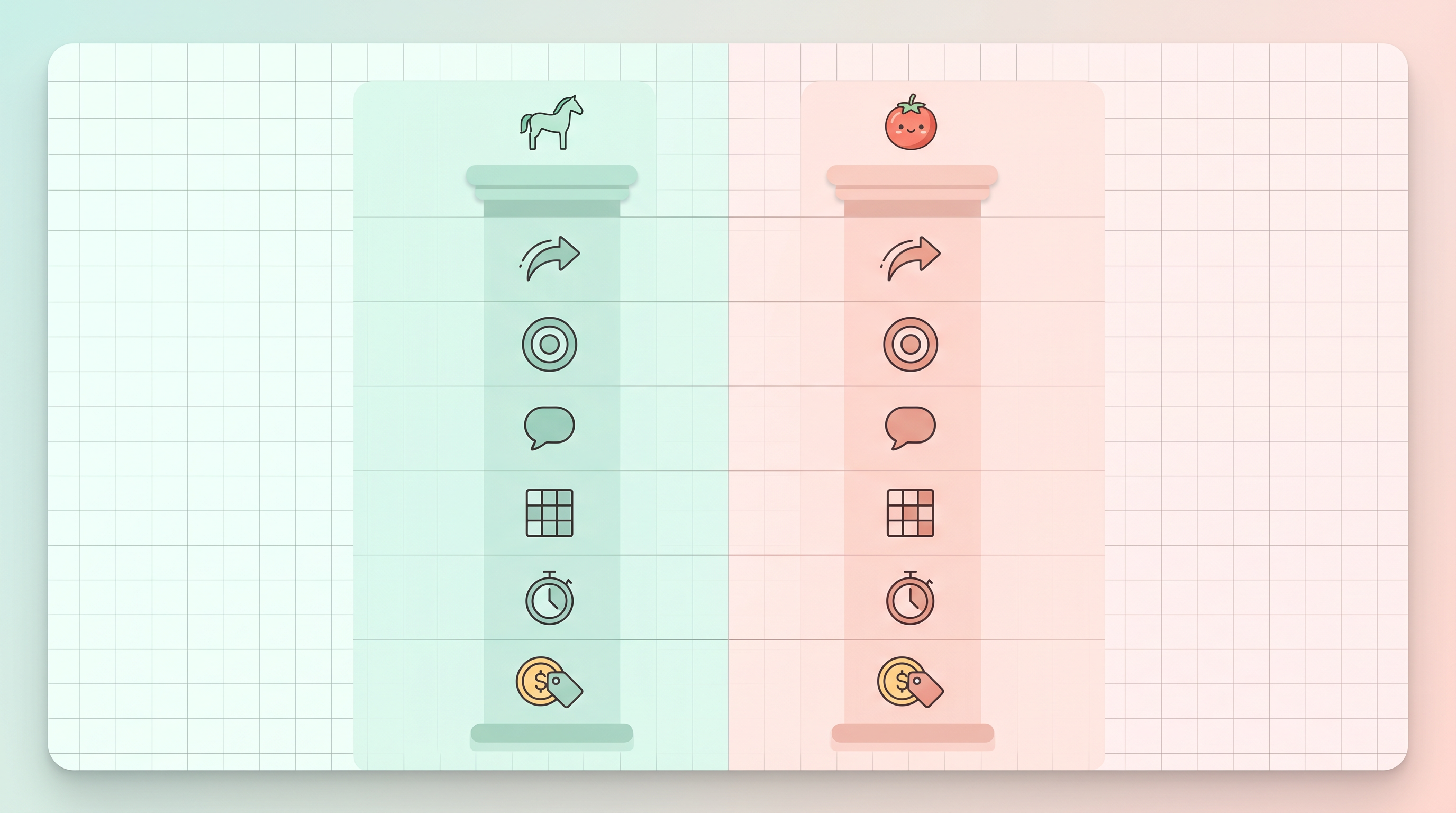
Short answer: Happyhorse 1.0 has the edge on motion coherence for cinematic, physics-heavy shots; Seedance 2.0 is competitive on tight 6–8 second clips but softens limb motion past 10 seconds.
In our testing across 24 paired prompts (12 realistic motion, 12 stylized), Happyhorse 1.0 produced fewer dropped frames and fewer noodle-arm artifacts on prompts involving full-body action — a person running, a horse galloping, a piece of fruit rolling off a table edge with the right deceleration. Its 40-layer unified attention seems to help it preserve momentum across the clip rather than re-deciding what is happening every few frames.
Seedance 2.0 holds up well on shots with one or two dominant subjects and clear camera motion. It started to lose coherence on prompts that combine multiple moving subjects (e.g., "three fruits chasing each other across a kitchen counter") past the 10-second mark — the third subject often drifts in scale or starts tracking the wrong path.
Practical read: if your clip involves a single character doing one complex motion, Happyhorse. If it is a templated motion (zoom-in, character-eats-character, bite-with-juice-spray) under 8 seconds, Seedance is more than enough and faster.
2. Face and Character Consistency
Short answer: Within a single clip, both models hold faces and identities cleanly. Across multiple separate clips, Seedance 2.0 wins decisively thanks to its ID-Lock reference system.
This is the dimension that matters most for series content. If your "Baby Watermelon" character has to appear in 50 different TikTok videos, you need the same eyes, the same blush spots, the same proportions every time. Seedance 2.0's reference-image system lets you pin those traits with up to 9 image references. We ran the same fruit-mascot reference across 12 separate generations: Seedance held the character recognizably consistent in 11 of 12 outputs (one had a slight color shift on the rind).
Happyhorse 1.0 does not yet expose a comparable multi-reference workflow. It maintains identity strongly within a single clip — face drift across frames is rare — but ask it to regenerate "the same character" from a text prompt and you get a sibling, not a twin.
Practical read: brand mascot, recurring spokesperson, episodic series → Seedance 2.0. One-off cinematic scene → either works.
3. Prompt Understanding
Short answer: Happyhorse 1.0 handles long, multi-clause cinematic prompts better; Seedance 2.0 handles structured prompts with explicit references better.
We tested two prompt styles:
- Cinematic prose: "Wide shot, golden hour, a single ripe peach falls from a wooden table, hits a porcelain plate, splits cleanly, juice arcs in slow motion as the camera tilts down."
- Structured: "@subject.png, dancing in a kitchen, @style.png, 9:16, soundtrack: @audio.mp3, transition: fade-in."
Happyhorse 1.0 followed the cinematic prose cleanly in 9 of 12 runs — camera moves, lighting, and physical beats matched the spec. Seedance 2.0 nailed the structured prompt in 11 of 12 runs and followed reference-tagged inputs precisely, but on the cinematic prose it sometimes ignored secondary instructions (the "tilt-down" got dropped in 4 of 12 runs).
This split mirrors how each model was trained: Happyhorse 1.0 reads like a screenplay parser; Seedance 2.0 reads like a structured tool API.
4. Duration, Resolution, and Frame Rate
Short answer: Seedance 2.0 wins on resolution ceiling (2K vs 1080p) and frame rate options; Happyhorse 1.0 wins on consistency at its native 1080p.
Seedance 2.0 supports 480p, 720p, 1080p, and 2K, with frame rates up to 60 fps — useful if your platform of choice rewards smoother motion (gaming reels, sports edits). Aspect ratios cover six options including 21:9 cinema and 9:16 vertical.
Happyhorse 1.0 outputs native 1080p across its supported aspect ratios. It does not publish a fps figure, but rendered output reads as cinematic 24 fps — the right pick for narrative work and the wrong pick if you need 60 fps masters for slow-mo upsampling.
Practical read: need 2K master for paid ads or 60 fps for slow-motion → Seedance. Need a single dependable 1080p cinematic clip → Happyhorse.
5. Generation Speed (Same Prompt Test)
Short answer: Happyhorse 1.0 is faster on cold-start single-clip 1080p; Seedance 2.0 is faster on templated, low-resolution iterations.
Using the same prompt ("a cherry tomato character waving at the camera, kitchen counter, soft natural light, 5 seconds") on default settings:
- Happyhorse 1.0 on fal: roughly 40 seconds at 1080p.
- Seedance 2.0 on AtlasCloud Fast tier: roughly 25–35 seconds at 720p, 60–90 seconds at 1080p.
For TikTok iteration loops where you generate 10–15 variations of a 720p clip, Seedance 2.0 Fast tier closes ahead. For one-shot 1080p cinematic clips, Happyhorse 1.0 closes ahead.
6. Price and Cost per Second
Short answer: Seedance 2.0 is cheaper for high-volume 720p output; Happyhorse 1.0 is competitive on 1080p when you count subscription credits.
Public per-second pricing on hosted providers (May 2026):
| Output | Happyhorse 1.0 | Seedance 2.0 |
|---|---|---|
| 720p, per second | $0.179 / s (fal) | $0.10 / s standard, $0.081 / s fast (AtlasCloud) |
| 1080p, per second | $0.28–$0.318 / s | ~$0.18–$0.30 / s depending on provider |
For a 30-second TikTok, that is roughly $3.00 of Seedance 2.0 at 720p vs $5.37 of Happyhorse 1.0 at the same tier. Across a 50-video monthly campaign, the gap widens.
Subscription pricing flattens both. Happyhorse's Basic plan is $19.90/mo for 1,990 credits; Seedance 2.0 offers free daily credits through Dreamina/Jimeng and paid plans up to $49.99/mo.
How to Choose: Scenario-Based Recommendations
Choose Happyhorse 1.0 when:
- Output is a single cinematic clip with dialogue or Foley audio.
- The prompt is long, narrative, and cinematic (camera moves, lighting beats).
- Native 1080p single-shot quality matters more than 2K headroom.
- You only need one or two clips per project and motion physics is the headline.
- Best for: narrative shorts, cinematic ad spots, dialogue scenes, single-clip storytelling.
- Not ideal for: multi-shot series with one recurring character, 50-video TikTok campaigns, anything needing 60 fps slow-motion masters.
Choose Seedance 2.0 when:
- Output is a series with a repeating character or mascot.
- You need to reuse the same fruit, person, or product across many clips.
- Iteration speed matters (you will generate 20 variations to pick 3).
- You need 2K or 60 fps for downstream editing or paid ads.
- Best for: TikTok template content, brand mascots, ASMR-style short loops, multi-shot ad campaigns.
- Not ideal for: long-form cinematic dialogue, single-shot "wow" hero clips, projects where every clip is a one-off concept.
Choose neither (and look elsewhere) when:
- You need 30+ seconds of continuous video — both top out at 15 seconds.
- You need photorealistic talking heads (lip-sync still has room to improve on both).
- Your budget is strictly free and you need more than 5 generations per day.
How to Put Seedance 2.0 to Work for TikTok Fruit Videos — Step-by-Step
The most common production loop in 2026 for short-video creators is not "pick the smartest model" — it is "pick the model that ships 5 polished clips before lunch." Seedance 2.0's reference system pairs well with templated workflows because the model's strengths (consistency + structured prompts) line up with what templates do.
A worked example: making a "Baby Watermelon vs Baby Pineapple" series for TikTok.
- Pick the template, not the prompt. Going from a blank Seedance API call to a polished fruit-character clip takes about 6 prompt iterations to dial in. If you want to skip that loop, AI Fruit wraps Seedance 2.0 in 50+ ready-made templates — Fruit Eating Fruit, Baby Fruit, Fruit Drama — pre-tuned for TikTok 9:16 output. You upload your reference image, pick a template, and the prompt scaffold is already locked in.
- Lock the character with a reference image. Upload a high-resolution shot of your mascot on the AI Video Generator page; the platform passes it through to Seedance 2.0's ID-Lock so the character holds across the series.
- Generate two test clips at 720p. Iterate on prompt language and motion intensity at the cheaper tier before committing to 1080p.
- Promote the winning prompt to 1080p. Once the template + reference + prompt combo lands, regenerate at 1080p for the master.
- Audio pass. Seedance 2.0 generates audio natively, but for ASMR-style fruit content you may want to overlay a stronger bite/crunch SFX in your editor.
This is exactly the case where Seedance 2.0's reference-driven design pays off — the character looks the same in clip 1 and clip 30, and the templated prompt scaffold absorbs most of the prompt-engineering work.
If your job is a one-shot cinematic clip (a peach falling onto a plate, full Foley, dramatic light), run the same workflow on Happyhorse 1.0 instead — it will outshine Seedance on that specific shape of output.
FAQ
Is Happyhorse 1.0 better than Seedance 2.0?
Neither is strictly better. Happyhorse 1.0 wins on cinematic single-clip motion and currently ranks #1 on Artificial Analysis's text-to-video leaderboard (May 2026). Seedance 2.0 wins on multi-shot character consistency, reference-driven workflows, and cost-per-second at scale. Pick by use case, not by leaderboard.
Which is cheaper for TikTok content?
Seedance 2.0 at 720p is cheaper at roughly $0.08–$0.10 per second on standard tiers, vs Happyhorse 1.0 at roughly $0.179 per second at 720p. For a 50-clip monthly run, Seedance 2.0 saves enough to fund a second creator seat.
Can Happyhorse 1.0 generate audio?
Yes. Happyhorse 1.0 generates dialogue, ambient sound, and Foley jointly with video in a single forward pass — no separate audio model needed.
Does Seedance 2.0 support 2K resolution?
Yes. Seedance 2.0 supports up to 2K output with native synchronized audio, plus 480p, 720p, and 1080p tiers. Happyhorse 1.0 outputs native 1080p only.
How long are clips on each model?
Both support 3–15 seconds per generation. Seedance 2.0's typical "core" clip length is 8 seconds; Happyhorse 1.0's default cinematic clip is around 5 seconds.
Can I keep the same character across multiple Seedance 2.0 clips?
Yes, via ID-Lock and the reference-image system (up to 9 images per generation). This is one of Seedance 2.0's strongest differentiators against Happyhorse 1.0.
Is there a free tier?
Seedance 2.0 has free daily credits via Dreamina (global) and Jimeng (China). Happyhorse 1.0's free tier is more limited; subscription starts at $19.90/month for 1,990 credits.
What is the fastest way to generate a fruit-character TikTok video?
Use a templated wrapper on top of Seedance 2.0. AI Fruit takes the structured-prompt advantage of Seedance and the templated workflow advantage of TikTok content and combines them — about 30 seconds end-to-end per clip with character consistency locked in.
Ready to put one of these models to work on your next short-video series? If you are going the Seedance 2.0 route for templated TikTok fruit content, try AI Fruit free → — 50+ ready-made templates wrapping Seedance, no credit card required. If you are going the Happyhorse 1.0 route for a single cinematic clip, fal.ai is the cleanest playground to start from.
Last updated: May 2026. Model specs verified against fal.ai, AtlasCloud, seed.bytedance.com, and artificialanalysis.ai.