
ElevenLabs Is Now Worth $22B: How to Choose an AI Voiceover Tool for Your Videos
ElevenLabs is now worth $22B. Here's how to choose an AI voiceover tool for your videos: capability limits, pricing, commercial license, and workflow fit — with October 2026 prices.

ElevenLabs just closed a $300 million employee tender offer that values the company at $22 billion — double its valuation from February. If you make short videos, the news matters less for the number and more for what it confirms: AI voiceover is now core infrastructure for video, and the tools for adding narration to your videos are mature enough that you should pick one on price, licensing, and workflow fit — not on hype.
That decision is exactly where creators get stuck. Voice quality demos all sound impressive. Pricing pages hide the catch until you hit it. And the licensing rules — can you actually use this voice in monetized videos? — are buried in plan tables. This guide gives you the four criteria that decide the pick, compares three self-serve options using their own published pricing (checked October 2, 2026), and shows how a voice track fits into a modern video workflow.
What the $22B tender actually tells creators
The facts first, from ElevenLabs' own announcement: the $300 million employee tender values the company at $22 billion, led by Wellington and T. Rowe Price, with first-time investments from Goldman Sachs, GIC, EQT, and others. Enterprise customers now account for 55% of revenue, the company has grown past 800 employees, and it raised its first round in 2022 at just $9 million — alongside Eleven v1, its first text-to-speech model. Four years later it ships Eleven v4 and v4 Turbo, which the company describes as its fastest and most emotive models yet.
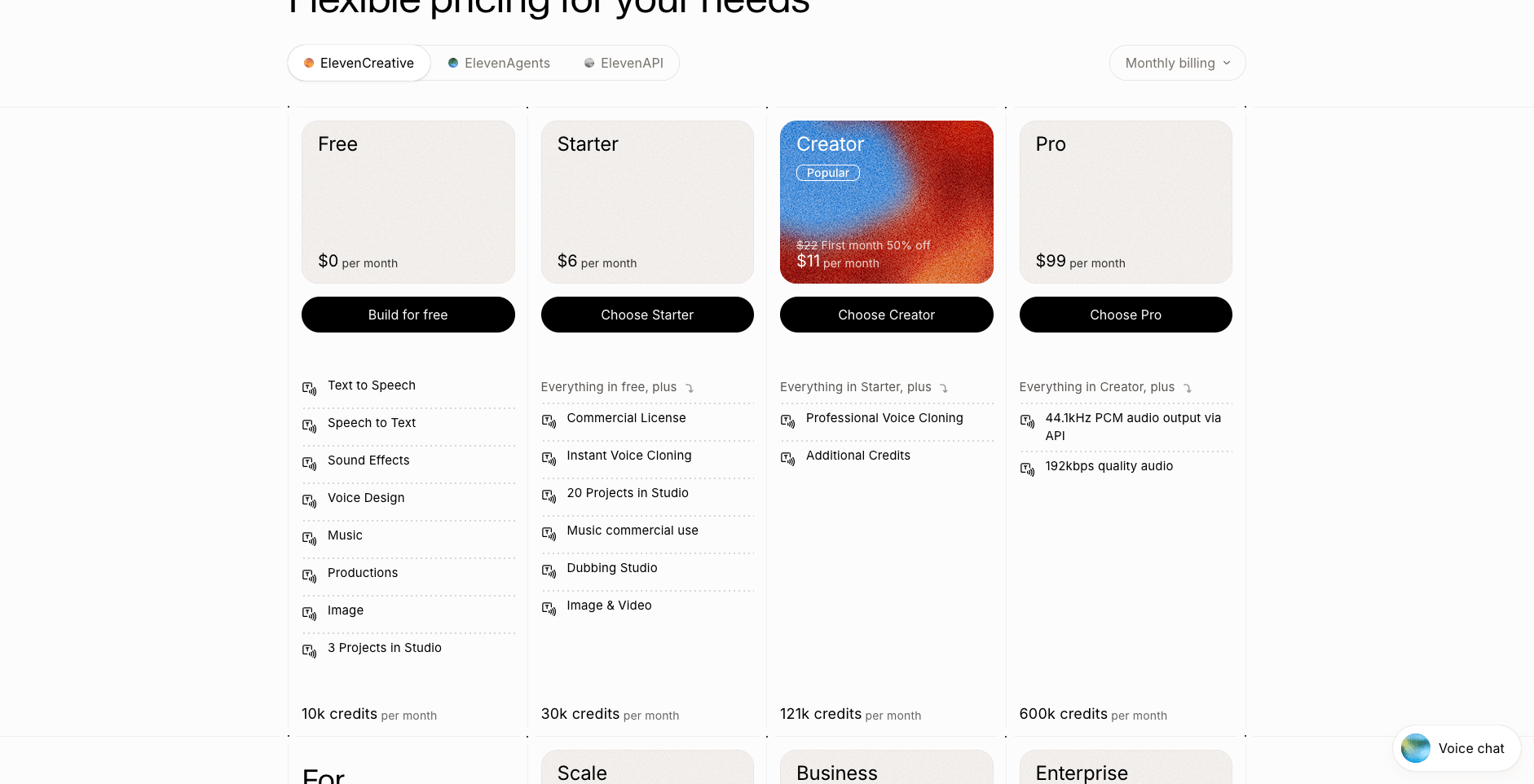
ElevenLabs pricing (monthly billing), accessed October 2, 2026. Source: elevenlabs.io/pricing
Three takeaways for a working creator:
- Voice AI is consolidating at the top. A $22B valuation funds years of model improvement and enterprise sales. The leader isn't going anywhere, so whichever tool you pick, the category will keep improving underneath you.
- The creator market is no longer the growth story. With enterprise at 55% of revenue and voice agents handling 15+ million conversations a week (company figures), consumer plans are a mature, competitive product line — which means stable pricing and real alternatives for you.
- Model quality is a moving target. New model versions arrive fast. Don't lock a long-term judgment of "best voice" into your workflow; lock in the criteria instead.
The four criteria that actually decide the pick
Every voiceover tool comparison eventually turns into a feature list. For short-form video, four criteria do most of the deciding.
1. Capability boundary — what the tool can and can't produce
Check three specifics against your scripts, not the demo reel:
- Languages and accents you actually publish in. ElevenLabs' pricing table lists 74 languages for its text-to-speech plans; Murf lists 150+ voices across 35+ languages on its pricing page. Your language is either well-supported or it isn't — test your own script before committing to a plan.
- Voice cloning and voice design. Cloning your own voice is the difference between a generic narration and a consistent channel identity. On ElevenLabs, instant voice cloning starts at the Starter tier. On Murf's self-serve page, a voice changer is documented at $0.10 per minute — confirm current voice-cloning availability on its plan page before relying on it.
- The edges of the job: dubbing, sound effects, translation. If your workflow includes localizing videos or generating sound beds, a platform that bundles those helps: ElevenLabs' pricing page lists dubbing and text-to-sound-effects options, and Murf's page lists translation at $0.02 per 1,000 characters.
2. Pricing model — subscription credits or pay-per-use
The two models reward different creators:
- Subscription with monthly credits (ElevenLabs): plans run from Free (10k credits/month, no commercial use) through Starter ($6/month, 30k credits) and Creator ($22/month, 121k credits) up to Business ($990/month, 6M credits), on monthly billing as of October 2026. Predictable, but watch the credit burn rate — extra minutes are listed from about $0.36 on the Free plan down to about $0.17 on Pro plans and above.
- Pay-as-you-go credits (Murf's self-serve pricing): $10 of free credits per month, then text-to-speech from $0.01 per 1,000 characters (Falcon model) or $0.03 per 1,000 characters (studio quality), with purchased credits that never expire. Better for irregular publishing rhythms.
- Raw API pricing (OpenAI): the gpt-4o-mini-tts model is priced at $12 per million output audio tokens plus $0.60 per million input text tokens per OpenAI's published pricing. There's no per-minute sticker in the token table — you (or the tool you build) pay per audio token. This route only makes sense if you're comfortable wiring an API into your pipeline.
Rough sizing helps: a typical 60-second short uses a script of roughly 150–180 words — under 1,000 characters for English. At Murf's $0.01/1k-character rate, that's a fraction of a cent per voice track; at ElevenLabs' paid tiers, the constraint is the monthly credit pool rather than the per-track cost. Do this arithmetic with your real publishing volume before choosing a plan level.
3. Commercial license — the clause that burns channels
This is the criterion creators skip and regret. Free tiers across the category commonly exclude commercial use, and "monetized TikTok" is commercial use. The documented example: on ElevenLabs' pricing comparison table, commercial use begins at the Starter tier — the $0 plan does not include it. If you publish ads, sponsored posts, or monetized shorts, your tool's free tier is not a trial of the product; it's a trial of the sound.
Two habits to adopt:
- Read the commercial-use line of the pricing table before the voice list. It's the cheapest due diligence in content creation.
- The same check applies outside dedicated voice tools — some video editors ship built-in text-to-speech with their own license terms, and "free and built-in" doesn't automatically mean "cleared for monetization."
4. Workflow fit — where the voice track enters your pipeline
The fastest workflow wins, and it depends on how you make videos:
- App-based tools (ElevenLabs' studio, Murf) export audio files you drop into CapCut, Premiere, or Resolve alongside your footage.
- API access (ElevenLabs, Murf, OpenAI) lets you script the whole pipeline — useful if you batch-produce.
- AI-generated video changes the sequence: if your visuals come from a video generator, check whether the model already produces embedded audio (several models offer it, at a higher credit-per-second rate than silent output on those models), then decide if you still need a separate narration track.
How the three documented options compare
All figures below come from the vendors' own published pages, accessed October 2, 2026. This is a documentation-based comparison, not a quality ranking — no independent voice-quality testing was performed for this article, and vendor benchmark claims (including ElevenLabs' for v4) are reported as claims.
| Criterion | ElevenLabs | Murf (self-serve) | OpenAI TTS API |
|---|---|---|---|
| Entry paid price | $6/mo (Starter) | Pay-as-you-go from $0.01/1k chars | $12/1M output audio tokens |
| Free tier | 10k credits/mo, no commercial use | $10 credits/mo | Pay per token, no free tier listed |
| Commercial use | Starter tier and above | Per self-serve terms — confirm at checkout | Per OpenAI usage terms |
| Languages listed | 74 (TTS pricing table) | 35+ (150+ voices) | Model-dependent |
| Cloning / voice design | Instant cloning from Starter tier | Voice changer documented ($0.10/min) | Voice prompt via API |
| Best fit | Consistent channel voice, dubbing needs | Irregular volume, budget control | Developers building pipelines |
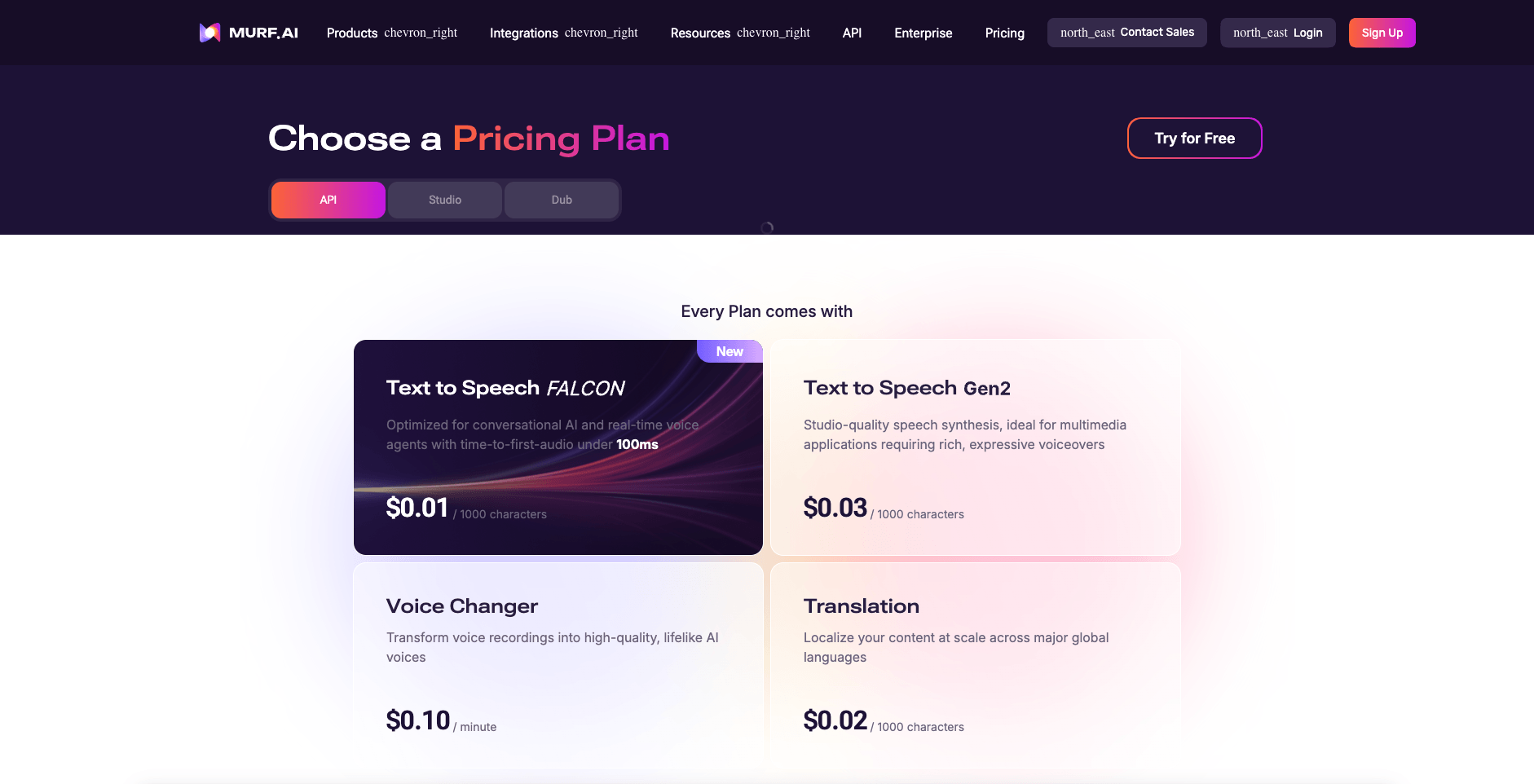
Murf self-serve pricing, accessed October 2, 2026. Source: murf.ai/pricing
The honest summary: ElevenLabs is the documented deep bench — more languages, cloning tiers, plus listed dubbing and sound effects, and the clearest published license ladder. Murf's pay-as-you-go math is the friendliest for sporadic publishing. OpenAI's TTS is a build-it-yourself component, not a creator studio. None of that tells you which voice you prefer — spend one hour generating the same script in each before you pay for a month.
Fitting a voice track into your video workflow
Once you have the voice file, the rest is assembly — and this is where AI-generated video changes the order of operations for a lot of creators:
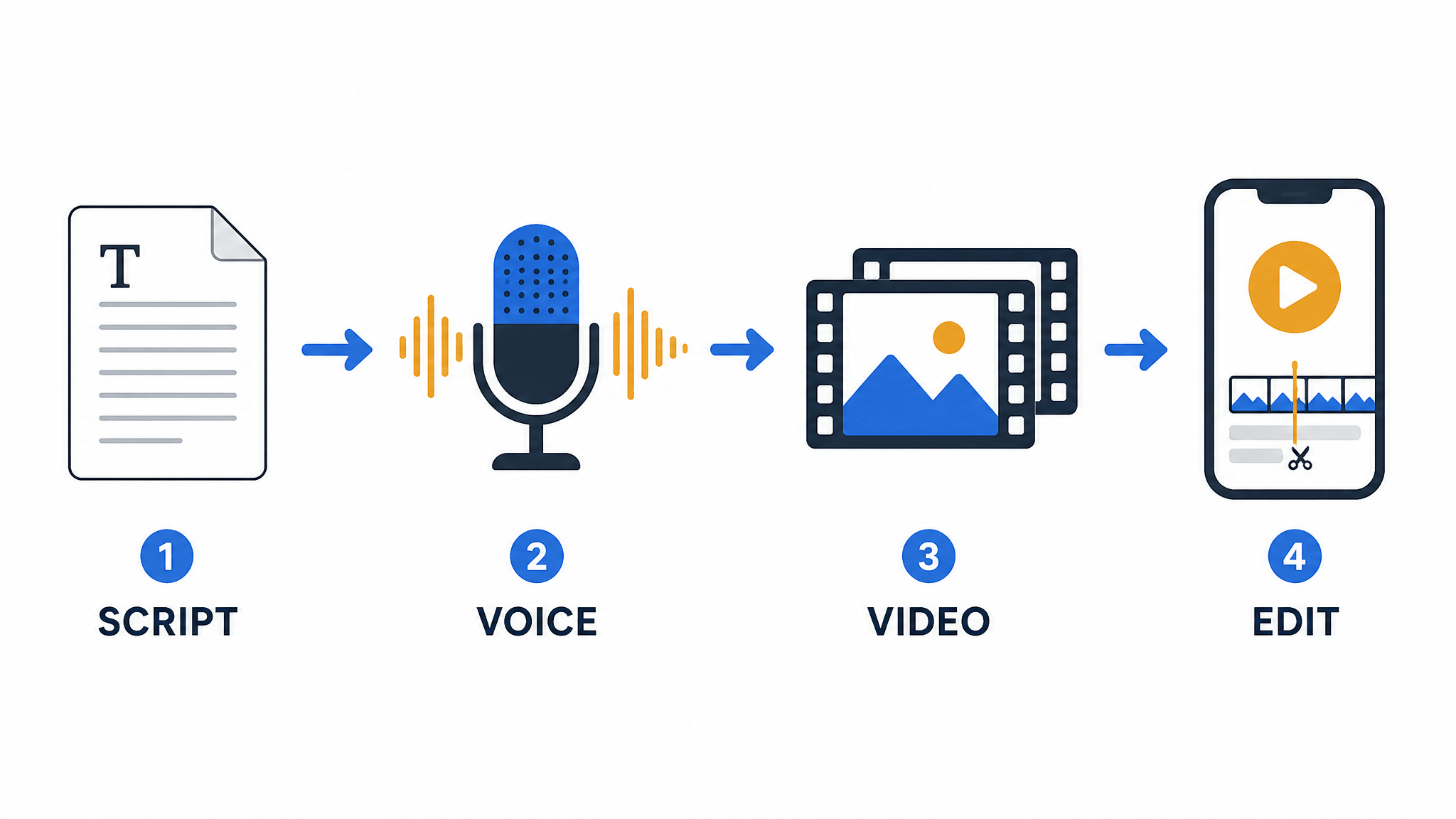
- Script — write for the ear: short sentences, front-loaded keywords, one idea per line.
- Voice track — generate, then listen once at full length; clipping artifacts and mispronounced product names are the usual failures.
- Visuals — shoot, or generate. This is the step AI Fruit sits in: it's an AI video generator built for short-form fruit-style videos, where you pick a model and see the credit cost before generating — and several models offer optional embedded audio at a higher credit-per-second rate than silent output, so you can decide per video whether generated sound covers you or you still need a narrated track.
- Assembly — drop the voice file over your visuals in any editor, sync cuts to the narration, export for the platform.
If you're generating the visuals with AI and adding voice separately, AI Fruit's video generator handles step 3 with per-model audio options and upfront credit pricing — the voice tools above handle step 2.
Decision shortcuts
- Just starting, publishing weekly or less: stay free until you monetize, then take the cheapest tier that grants commercial use (ElevenLabs Starter at $6/month is the documented example).
- Shipping daily and cloning your own voice: subscription tiers with cloning included pay off — compare credit pools against your real script volume.
- Batch-producing with automation: API pricing (OpenAI's gpt-4o-mini-tts, or ElevenLabs'/Murf's APIs) beats app plans, if you can wire the pipeline.
The bottom line
ElevenLabs' $22 billion valuation is a milestone for the voice AI category, but your tool choice was never going to be settled by one company's tender offer. Decide on the four criteria — capability boundary, pricing model, commercial license, workflow fit — run one script through your two finalists, and check the license line before you check the voice list.
And when the voice track is ready but the visuals aren't, AI Fruit generates the video side — model choice and credit cost visible before you spend anything.