
AI Voiceover for Videos: How to Use Nari Qwen3-TTS, the New Benchmark Leader
Nari's Qwen3-TTS topped Coval's voice AI benchmarks on Sep 14 at $5–10 per million characters. What it means for short-video voiceover, plus a documentation-based workflow to add AI narration to your videos.

Adding narration to a finished video is the last mile before posting — and as of September 14, 2026, that last mile got dramatically cheaper. Nari Labs announced that its Qwen3-TTS and Qwen3-ASR endpoints now top Coval's voice AI benchmarks, ranking #1 in text-to-speech accuracy and #1 in speech-recognition latency among publicly available models, at prices that undercut ElevenLabs and Cartesia by 5–6x. If you add AI voiceover to videos — talking-head intros, product demos, faceless shorts — a new realistic default just appeared.
This guide explains what the benchmark lead actually means for short-video creators, then walks through a documentation-based workflow for generating narration with Nari Qwen3-TTS and dropping it into your editing timeline. One note before the numbers: Coval's boards update roughly every 30 minutes, so treat every figure below as a timestamped snapshot, not a permanent fact.
What actually happened
Coval runs continuously updated leaderboards for voice AI, measuring latency (time-to-first-audio for TTS, time-to-final-segment for STT) and Word Error Rate (WER). In Nari's announcement post, based on Coval's one-day view as of September 14, 2026 at 15:00 UTC:
| Benchmark | Result (Sep 14 snapshot) |
|---|---|
| TTS accuracy | Qwen3-TTS Fast: #1 WER at 3.8% (of 28 models) |
| TTS latency | Qwen3-TTS Fast: #2 median TTFA at 63 ms, behind Fluxions' 300M vui (49 ms) |
| STT latency | Qwen3-ASR Fast: #1 time-to-final-segment at p50 44 ms |
| STT accuracy | Qwen3-ASR Fast: #2 WER at 3.6%, behind AssemblyAI Universal 3.5 Pro (3.5%) |
We re-checked the live TTS board at roughly 00:30 UTC on September 15: Nari still held the lowest WER (3.8%), while vui's median TTFA read 51 ms. The STT board had already shifted — Baseten's dedicated Qwen3-ASR endpoint led TTFS at 22 ms, and AssemblyAI led WER at 3.4%. Rankings move; the meaningful, stable story is the price-performance position, not a specific rank on a specific day.
The pricing is the part creators will feel. Nari's TTS Fast endpoint costs $10 per million characters — tied for the cheapest in Coval's pricing directory — and the Standard endpoint is $5, the lowest. Nari's post compares that to ElevenLabs Eleven v3 Conversational at 5x the price and Cartesia Sonic 3.6 at 6.5x. On the STT side, Fast runs $0.12 per hour of audio with Standard at $0.06, against $0.45 for AssemblyAI's Universal 3.5 Pro and roughly $0.29 for Deepgram Nova 3.
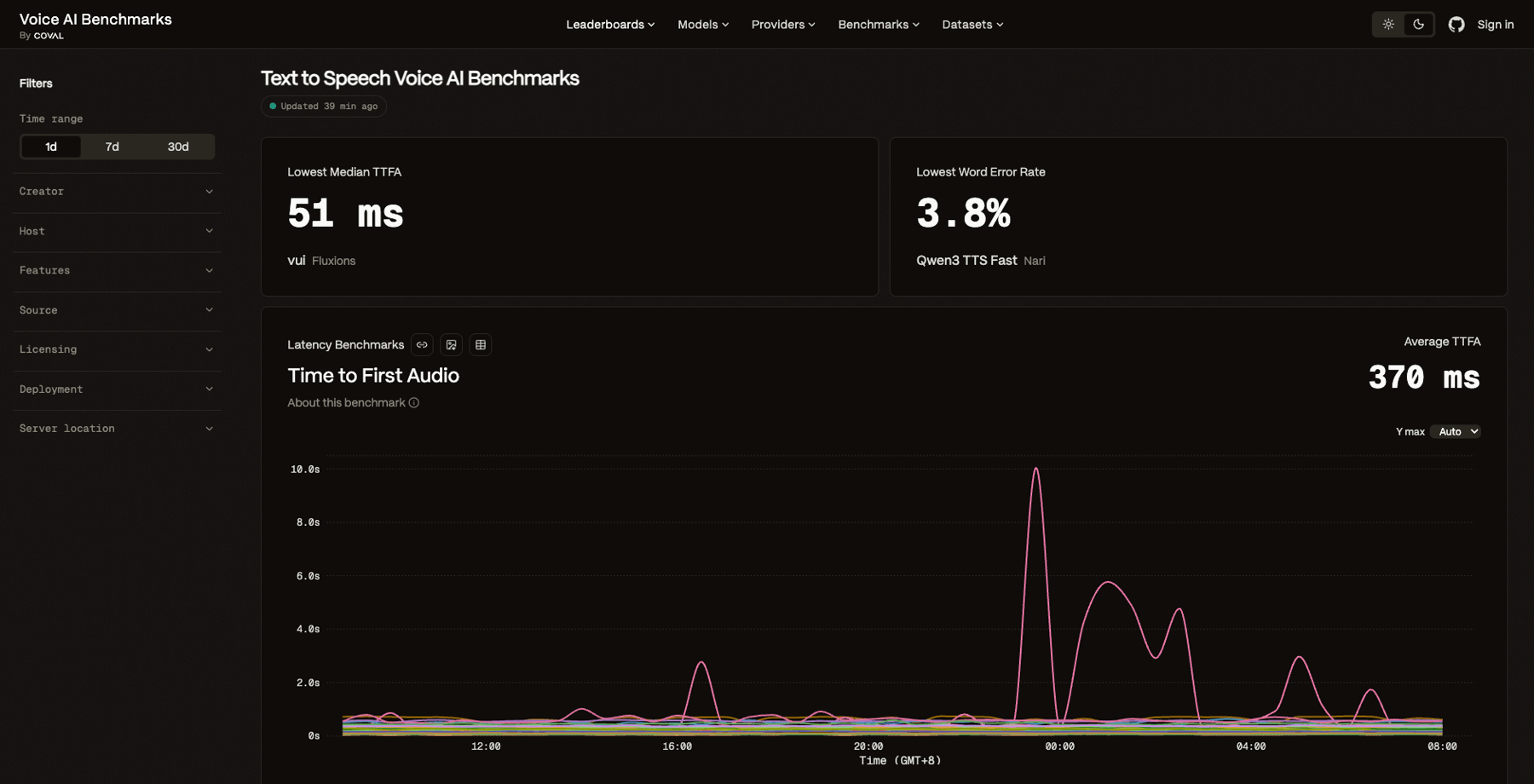
Coval TTS leaderboard as checked at ~00:29 UTC, Sep 15, 2026 (1-day view). Source: benchmarks.coval.ai — values update about every 30 minutes.
There's also a quietly important detail in the data: the same underlying Qwen3-TTS model shows wildly different results depending on who serves it. Alibaba's official Qwen3 TTS Flash Realtime endpoint posted 8.8% WER and 692 ms median TTFA; Baseten's dedicated deployment landed at 6.0% and 101 ms; Nari's optimized endpoint at 3.8% and 63 ms. For an open-weight model — the Qwen3-TTS 1.7B family is published on Hugging Face — serving quality is the product. That's the actual bet Nari (Y Combinator-backed) is making with its "optimized open-source models" positioning.
Why this matters for the last mile of a short video
A 30–60 second short typically carries 100–160 words of narration — roughly 600 to 1,000 characters. At Nari's Standard rate of $5 per million characters, one full voiceover pass costs about half a cent; even a workflow that regenerates every line ten times stays under five cents per video. You don't pick a TTS endpoint for short-form narration because of cost alone anymore — you pick it for iteration speed, and that's where the benchmark numbers translate directly: lower time-to-first-audio means faster feedback when you're rewriting one line for the fourth time.
Latency separates the two variants. Nari's Fast endpoint (50 ms TTFA advertised) exists for realtime voice agents that talk with humans; its Standard endpoint (200 ms) targets batch workloads. Rendering a voiceover file is a batch job — but if your workflow involves interactively auditioning lines, Fast shaves noticeable friction at twice the per-character price.
How to add AI voiceover to a video with Qwen3-TTS
What follows is documentation-based — assembled from Nari's product page and announcement, not from our own production runs. Nari is in a free public beta moving to paid GA "within this week" of the September 14 post, with $20 in credits for accounts created before the switch — worth checking the current status before you build on it.
Step 1 — Write for speech, line by line. Narration scripts read differently from on-screen copy: short sentences, no parentheticals, numbers spelled the way they should sound. Keep one idea per line; line-per-line structure makes timing and regeneration trivial later.
Step 2 — Generate the audio with one HTTPS request. Nari's TTS API takes a single POST to /v1/audio/speech and returns a WAV file; switching between Fast and Standard is just a different model ID in the same request:
curl --fail --silent --show-error \
  https://api.narilabs.com/v1/audio/speech \
  -H "Authorization: Bearer $NARI_API_KEY" \
  -H "Content-Type: application/json" \
  --data '{
    "model": "qwen3-tts-fast:free",
    "input": "Your narration line here.",
    "voice": "diana",
    "response_format": "wav"
  }' \
  --output speech.wav
You choose from eight preset voices (Professional, Conversational, Youthful, Mature, Narration, Energetic, Explanatory, Articulate). Current TTS language support is English and Spanish — if your audience is in another language, this endpoint isn't for that track yet.
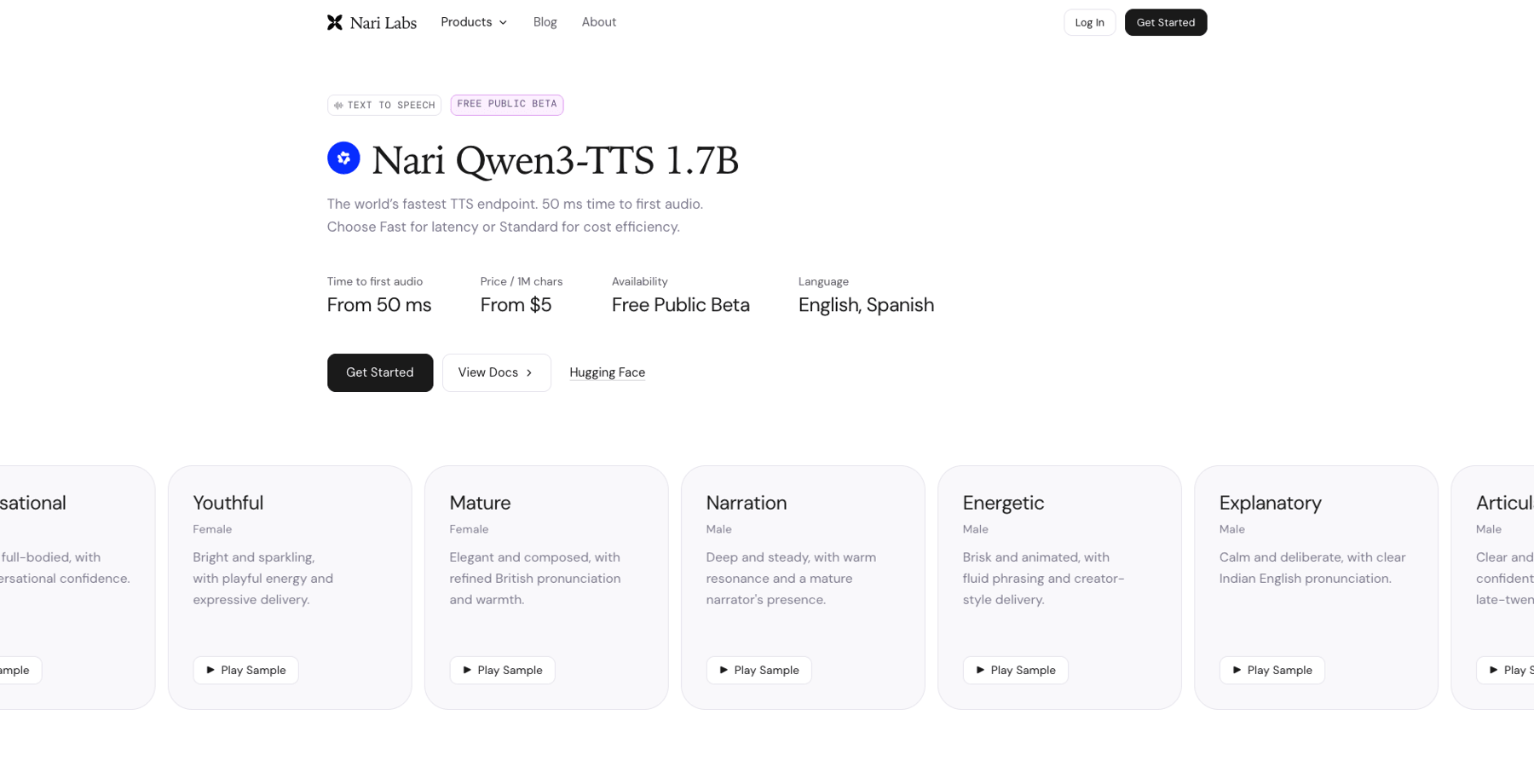
Nari Qwen3-TTS Fast and Standard variants and preset voices. Source: narilabs.com (checked Sep 15, 2026; free public beta at check time).
Step 3 — Drop the WAV into your editor and align to cuts. In CapCut, Premiere, or Resolve, place each narration line on its own audio track segment, nudged against the cut points. The practical trick with generated narration: regenerate lines, not takes. Because each request is fast and near-free at these prices, fixing one flat-sounding sentence costs one API call, not a re-record.
Step 4 — Export, then caption. For captions or subtitles, the same benchmark story applies to transcription: Nari's Qwen3-ASR Fast ranked #1 in STT latency in the September 14 snapshot, with automatic language identification across 30 languages over a WebSocket API. Generating an SRT from your own narration track is the same pattern in reverse.
Choosing between Fast and Standard
| Fast | Standard | |
|---|---|---|
| Advertised latency | 50 ms TTFA | 200 ms TTFA |
| TTS price | $10 / 1M chars | $5 / 1M chars |
| Best for | Interactive auditioning, voice agents | Batch narration renders |
For most publish pipelines, Standard is the sensible default — the render waits either way. Switch to Fast when your workflow gets interactive: testing voice fits, iterating lines against the timeline, or building an agent that speaks in realtime.
The honest limits
- Language coverage: TTS currently supports English and Spanish only. The ASR side covers 30 languages, but narration generation is the narrower tool today.
- Beta-to-GA transition: free endpoints were scheduled to become paid within a week of the announcement. Prices and the free tier may already have changed.
- WER is not expressiveness: Word Error Rate measures intelligibility, not whether a voice moves people. A #1 WER rank doesn't tell you the Narration voice beats ElevenLabs' in your niche — audition before you commit a channel to it.
- We haven't run it: this workflow is documentation-based; we haven't benchmarked audio quality ourselves or run production renders.
- Rankings fluctuate: Coval's boards update about every 30 minutes, and rankings exclude dedicated inference endpoints. Verify current numbers before citing them anywhere that matters.
Where voiceover sits in an AI video pipeline
For short-form creators, the pipeline now looks like this: generate or shoot the visuals, add narration, publish. If the visual side is your bottleneck — say, fruit-style AI clips for TikTok — that's a video generation problem, and it's the step AI Fruit handles: prompt-to-video with visible model choices and credit costs before you spend anything. Voiceover is the neighbor step this article covers: one script, one TTS request, one timeline pass.
The realistic takeaway from the September 14 benchmark news isn't that one leaderboard row changed. It's that the narration step — historically the part where you either recorded yourself or paid a subscription — now costs pennies, returns in milliseconds, and comes from an open-weight model family. The last mile got short. Walk it.
Ready to fill the first mile? Generate your video with AI Fruit, then add the voiceover with whichever endpoint tops the board that day.