
AI Video Content Pipeline: From One-Off Clips to a Content Stream
AI video now generates faster than playback. Here's the three-rung pipeline — one-off clips, batched series, always-on supply — with real numbers and the catches.

Last updated: September 2, 2026
A 24/7 AI-generated TV channel pulled 37,000 viewers on its first full day. Every clip on it was produced by a model that generates video faster than you can watch it — a milestone that arrived in late August 2026, not someday. If you make short-form video, the headline isn't "go build a TV station." It's that the real upgrade is a pipeline, not a channel: the creators who benefit first are the ones who stop producing clips one at a time.
Key takeaways
- fal's H3 Max (a post-trained version of MiniMax's open-weights H3 model) generates a 5-second 768p clip in under 3 seconds — roughly 35× the throughput of the official H3 endpoint, according to fal.
- Pieter Levels used that speed to launch Infinite Slop, an endless AI-generated live stream where chat decides what airs — 37,000 day-one viewers, sponsored compute.
- For working creators, the practical upgrade path has three rungs: one-off clips → batched series → always-on supply.
- The bottleneck has moved from render time to ideas, consistency, review, and distribution.
- Always-on supply is still expensive if every second is freshly generated — the cost math is the first gate, not the last.
What actually changed: video now generates faster than playback
For most of the AI video era, supply was rationed by render time. Generating a 15-second clip took roughly 2–5 minutes, by Pieter Levels' account, so your output was capped by how long you were willing to wait. A "content pipeline" was mostly a scheduling trick: queue prompts overnight, harvest clips in the morning.
That constraint broke on August 27, 2026, when fal released H3 Max, a post-trained version of MiniMax's open-weights H3 model. According to fal's announcement, H3 Max renders a 5-second 768p video in under 3 seconds — about 35× the throughput of the official MiniMax H3 endpoint and, on average, 15× faster than models of comparable quality. fal also reports that H3 Max ranked #1 in its head-to-head human preference evaluations against twelve leading models, and that independent rankings from Artificial Analysis and Design Arena place it #1 as well. Those are the vendor's and benchmarkers' numbers, not ours — but the speed claim is easy to sanity-check, because people immediately did things with it that slower models made impossible.
Levels' own summary: 15 seconds of video now generates in about 9 seconds. Faster than playback. That single ratio is what changed: when a clip renders quicker than it runs, render time stops being the constraint on how much content you can supply. The constraint moves somewhere else — to how many ideas you have, how consistent your characters and settings stay across clips, how fast you can review outputs, and how well you distribute what you make.
The 24/7 AI TV station is real — and it's the extreme end
Two days after H3 Max shipped, the speed claim became a live broadcast. Levels launched Infinite Slop: an endless, interactive AI-generated stream where viewers type prompts into chat and the system generates the next clip, trying to connect it to the previous one so a loose storyline emerges. fal sponsors the compute. The idea came from builder Rehan Sheikh (@rehan_shei), who had connected H3 Max directly to a Twitch stream first, and Marc-Antoine Fon. By the next day, Levels reported 37,000 viewers and registered InfiniteSlop.ai.
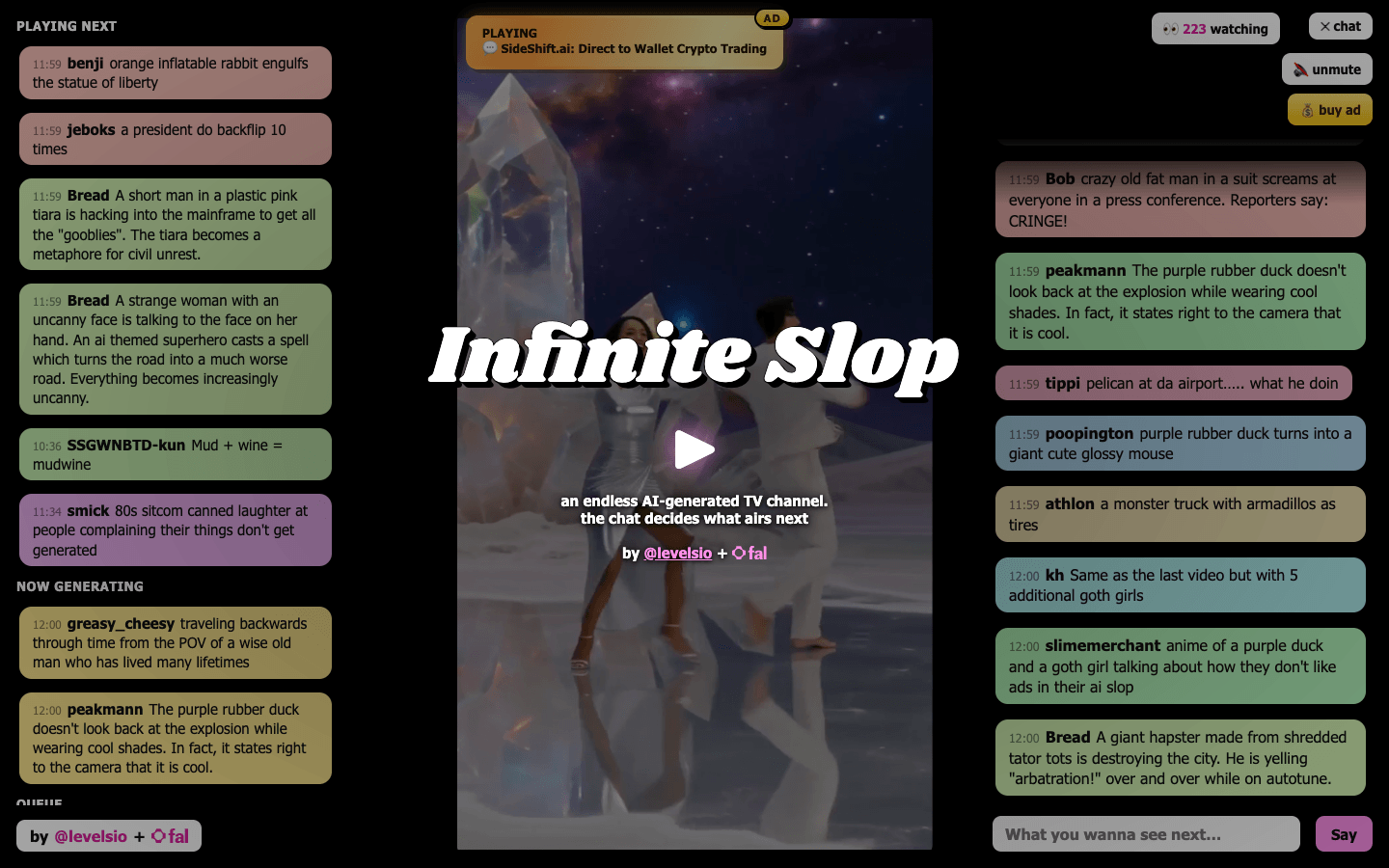
Infinite Slop by @levelsio + fal — the chat decides what airs next (screenshot: infiniteslop.ai, September 2, 2026)
MiniMax's own channels report the same pattern: H3 Max at 768P and 480P is now connected to its open platform and MiniMax Design, and overseas developers have used it to build Twitch livestreams and round-the-clock "AI TV stations" (as summarized by AIHOT from MiniMax's WeChat announcement).
But read the details before you treat a 24/7 channel as a template. Infinite Slop caps out at about four fresh 15-second clips per minute — the rest of the broadcast is queue, upvotes, and replays. And the fully-fresh version is brutally expensive: a third-party analysis by Steal What Works estimates that generating fresh 768p video 24/7 at fal's standard public price would run about $207,360 per month — consistent with Levels' own ~$210,000/month estimate for a profitable always-on stream. It works as a demo because a sponsor pays the bill and the audience supplies the ideas through chat. It's the extreme end of the ladder, not the entry rung.
The AI video content pipeline: three rungs for working creators
Between "one clip at a time" and "24/7 TV station" sits a practical ladder. Each rung changes what your bottleneck is.
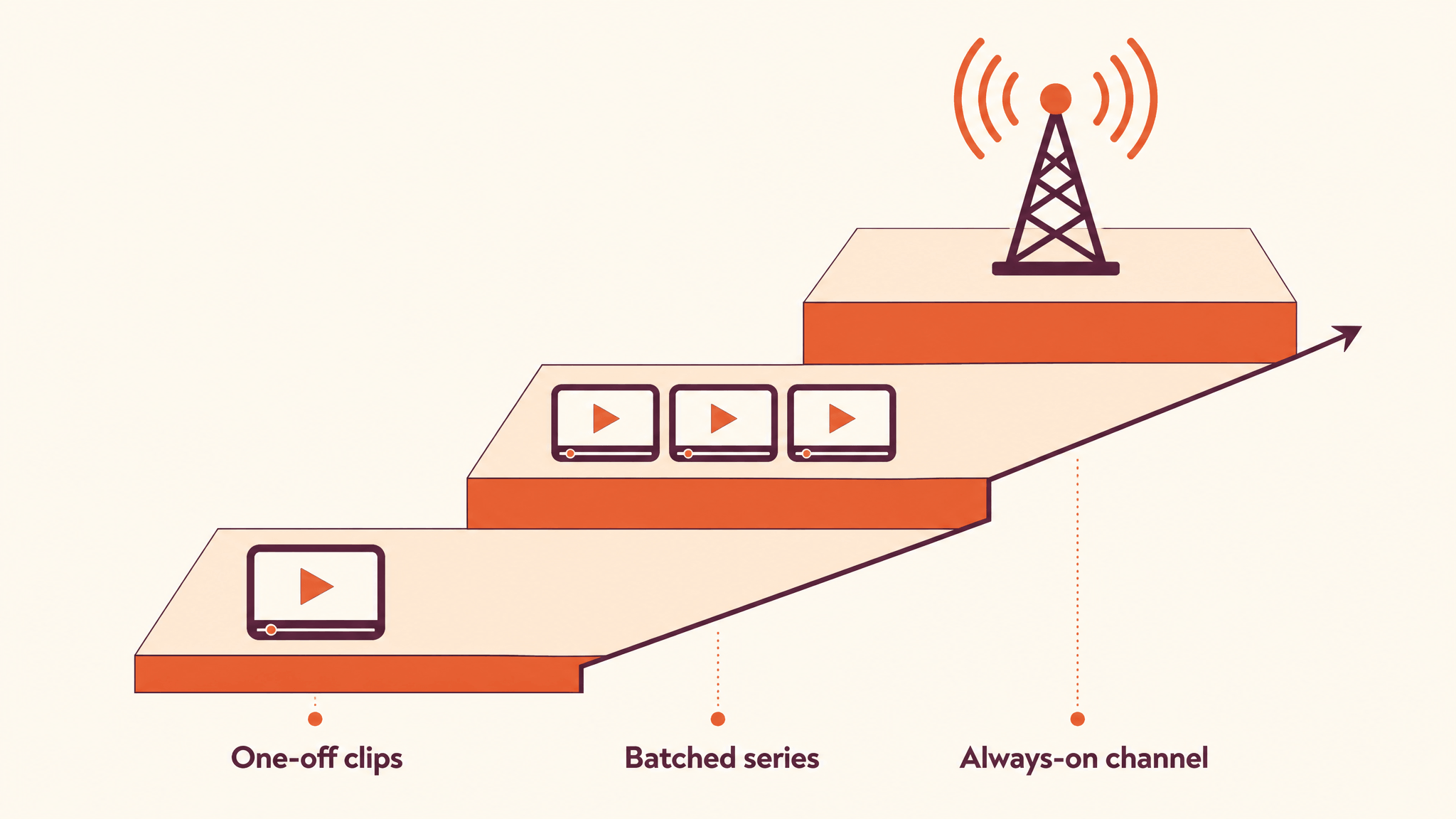
Rung 1 — one-off clips (where most creators are)
One prompt, one clip, one post. This is still the right mode for testing a hook or riding a trend, and there's no shame in staying here. The hidden cost is context loss: every clip starts from zero, so your best-performing character, setting, or joke doesn't carry into the next video unless you rebuild it by hand.
Rung 2 — batched series (the sweet spot)
Instead of making clips, make a series: one planning session that produces five to seven related clips — same character, same world, different beats. This is where faster generation pays off first, because the expensive part isn't rendering anymore; it's keeping the character and scene context coherent across clips while you work.
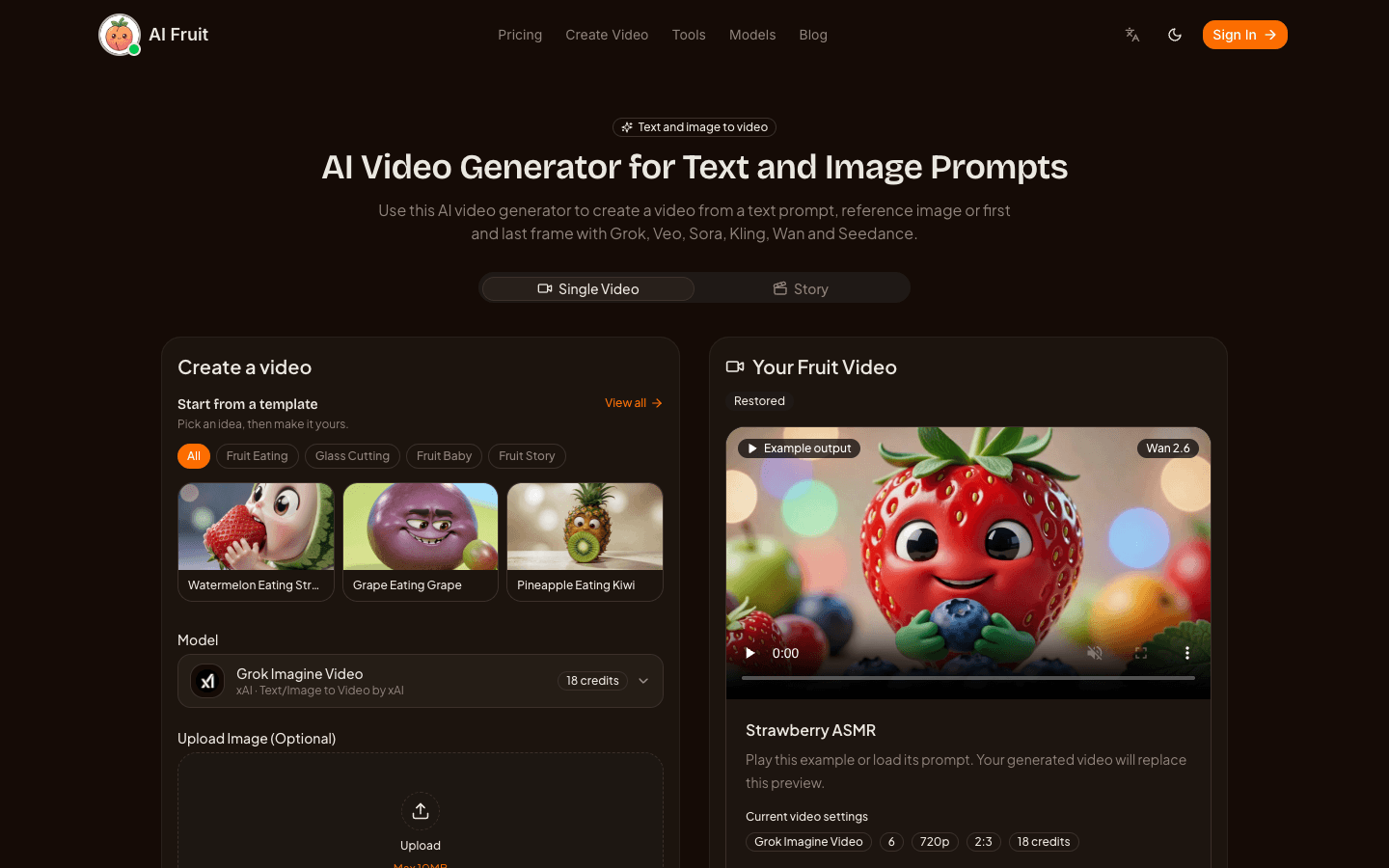
This is also the rung where a platform built for structured series helps. AI Fruit's generator, for example, splits its entry into Single Video and Story modes: a Story brief drafts a multi-scene storyboard, you generate scene by scene, pick the result that continues the story, and the workspace keeps your characters, scene context, results, and versions across clips — so batch-producing a fruit-ASMR series or a recurring character doesn't mean re-explaining your premise to the model every five minutes. (It's a series workflow, not a timeline editor — and no tool, AI Fruit included, guarantees perfect character consistency; you still review each result.)
Rung 3 — always-on supply (the TV-station end)
A channel that never stops is now technically feasible — Infinite Slop proves it — but for a solo creator it means solving three problems at once: fresh-versus-replay economics (Steal What Works notes levers like 480p output, replaying older clips in quiet periods, and reusing clips can cut the effective bill by 50–80%), continuous moderation of what your audience's prompts produce, and disclosure rules for AI content that platforms keep tightening. Run this rung only when rung 2 is already profitable and mostly automated.
The bottlenecks that replaced render time
Cost per clip. Fresh video is cheaper than it was but not cheap: the $207,360/month figure above is the extreme case, yet even a modest always-on habit compounds. The first financial gate for any pipeline is monthly generation spend versus the revenue the content actually drives.
Review bandwidth. When generation is fast, you become the quality filter. Infinite Slop offloads this to chat upvotes; a solo creator reviewing five to seven clips per session needs a triage habit — keep, regenerate, or cut — or the pipeline jams behind your own inbox.
The slop problem. Novelty pulled 37,000 viewers in a day; retention is the open question. Early coverage has been explicit that nobody yet knows whether Infinite Slop's audience comes back once the novelty fades. An "infinite" channel full of content nobody remembers is a hobby, not a pipeline. The fix upstream of the broadcast is a distinct, repeatable format — which is exactly what rung 2 builds.
Disclosure and platform rules. Major platforms now require or encourage labeling AI-generated content, and the rules are still moving. Check each platform's current policy before you scale output; a pipeline that gets flagged mid-week is a pipeline that stops.
A pipeline you can run this week
- Pick one repeatable format. Not "AI videos" — one premise narrow enough to repeat: a character, a setting, a ritual your audience can recognize in two seconds.
- Fix the constants. Lock the character design, setting, and format rules before writing any prompts. Constants are what make clip #6 cheaper to make than clip #1.
- Write prompts as variations, not one-offs. Five to seven beats of the same premise, planned together, so each clip inherits context instead of restarting it.
- Generate in one session, review each result. Choose the result that continues the series; regenerate the misses while the context is loaded. Plan the week's posting schedule before you close the session.
- Judge by retention, not views. A series works when people watch the next clip, not when one clip spikes. Give it two to three weeks of consistent output before deciding.
The bottom line
The 24-hour AI TV station is a genuine milestone — and a demonstration, subsidized by its compute sponsor, of what happens when generation gets faster than playback. For everyone who isn't Pieter Levels, the takeaway is smaller and more useful: the render wall is gone, so the thing standing between you and a content stream is no longer time. It's whether you have a format worth repeating and a process that keeps it consistent. Build the series first. The channel, if you ever want one, will be waiting.
If you're creating in the fruit-video niche — the watermelon-ASMR, dancing-strawberry corner of TikTok — you can batch a week of AI Fruit clips at aifruit.app.