Agentic Fruit Video Generation: Automate TikTok in 2026
Wire AI Fruit into an agentic video pipeline. Step-by-step workflow with Claude, ViMax, and AI Fruit to automate TikTok fruit content end-to-end.
 AI Fruit Team
Last updated: May 2026
A TikTok creator running a fruit ASMR account told me last week that posting 5 videos a day broke her — not the rendering, the everything else. Picking which trend to chase, writing the script, choosing the model, downloading, captioning, scheduling, replying. The video was the easy part. The orchestration was the wall.
This is exactly what agentic fruit video generation solves. Instead of one creator stitching tools together, you build a pipeline where small AI agents handle each stage — trend scouting, scripting, template selection, rendering, publishing — and you stay in the loop only for taste decisions. AI Fruit fits in as the rendering layer; Claude, ViMax, or your own orchestrator handles the rest.
This guide shows how to design that pipeline, where AI Fruit slots in, and walks through a complete demo workflow that produces 30 publishable TikTok fruit videos a week with maybe two hours of human attention.
Table of Contents
- The Challenge: One Creator, Five Tools, Zero Sleep
- How Agentic Video Workflows Solve This
- Practical Workflow: Step by Step
- Results & What to Expect
- Tips for TikTok Fruit Creators
- FAQ
The Challenge: One Creator, Five Tools, Zero Sleep
Most TikTok fruit creators today are operating a manual pipeline that already looks like an agentic workflow — they just don't have agents. A typical week looks like this: scrolling TikTok and Reddit for trend signals (2 hours), brainstorming concepts (1 hour), writing prompts (3 hours), testing renders across Wan, Seedance, and Hailuo (4 hours), exporting and editing in CapCut (3 hours), writing captions and hashtags (2 hours), scheduling posts (1 hour), responding to comments (open-ended). Sixteen-plus hours of orchestration for what is, fundamentally, a creative decision.
Three forces make this worse every quarter:
- Trend windows are shrinking. A fruit format that ran for three weeks in 2024 now peaks and dies in 5-7 days. Manual workflows can't ship 30 variations inside that window.
- Single-tool ceilings. No single video model is best at everything. Seedance wins on audio sync, Wan 2.6 wins on character consistency, Hailuo wins on motion realism. Switching between them by hand is friction.
- Volume burnout. TikTok's algorithm rewards posting cadence — accounts posting 3-5 times daily outperform accounts posting once. Sustaining that manually means either burnout or hiring an editor at $40/hour.
The creators winning right now aren't working harder. They're delegating the orchestration to agents.
How Agentic Video Workflows Solve This
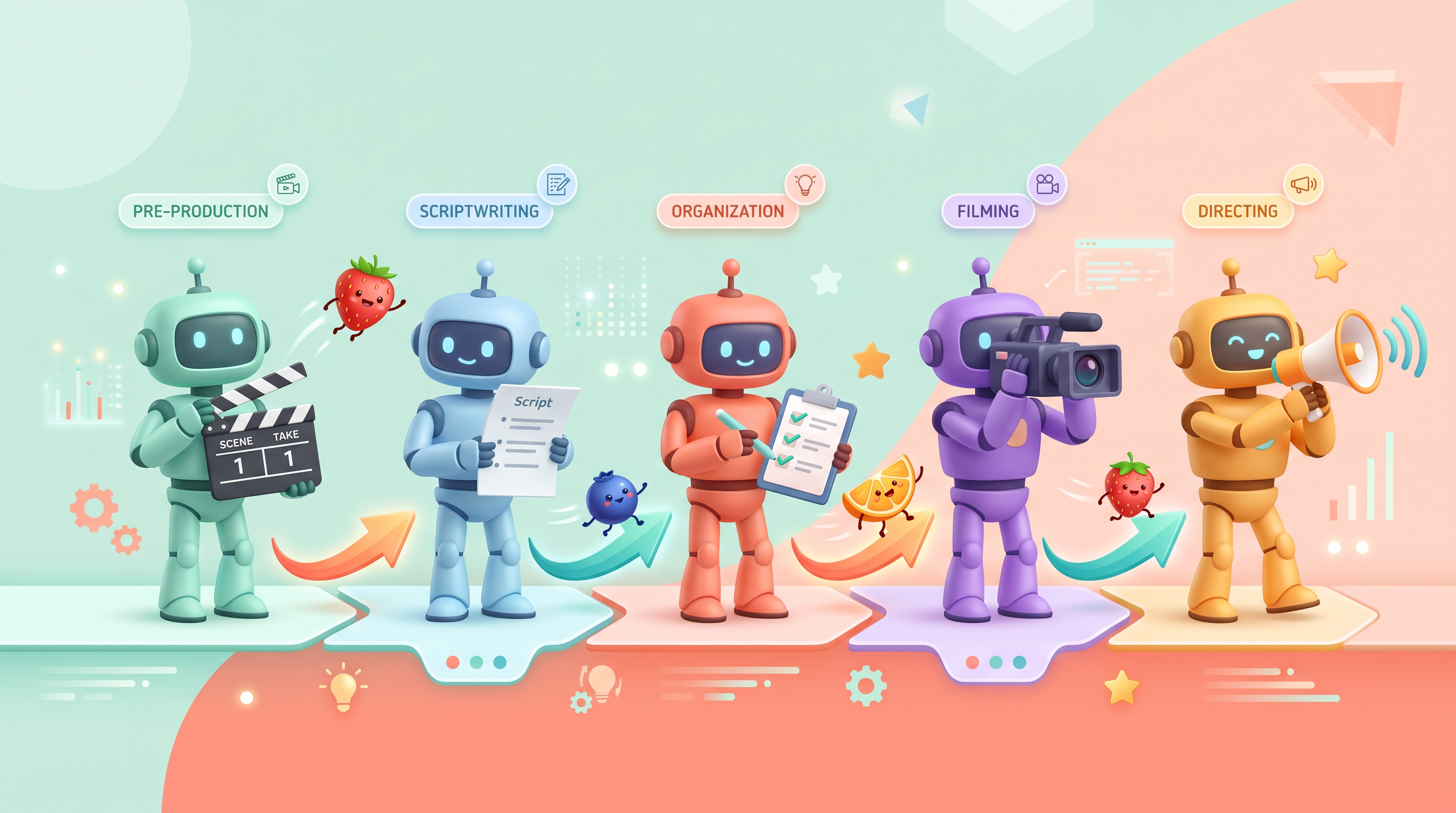
An agentic video workflow decomposes content creation into roles, then assigns each role to a specialized AI agent. The pattern comes straight from production studios: a director decides what to shoot, a screenwriter writes the script, a producer picks the cast and templates, a generator renders the shot, and a publisher distributes the output. ViMax (HKUDS/ViMax, GitHub Trending #17 on May 21, 2026) implements this exact architecture as an all-in-one Director, Screenwriter, Producer, and Video Generator system.
The key insight is that agentic fruit video generation is not one big model doing everything — it's a relay. Each agent does one job, hands off structured output, and the next agent picks up. This gives you three advantages a monolithic tool can't:
- Replaceable parts. When a better trend-scouting source appears, swap the scout agent. When Wan 2.7 ships, swap the render agent. Nothing else changes.
- Parallel runs. While one agent renders Monday's videos, another scouts Tuesday's trends, another writes Wednesday's scripts. You stop waiting on sequential steps.
- Human-in-the-loop where it matters. You approve trend picks and final cuts. You skip the boring middle.
AI Fruit fits this architecture as the render layer specialist. It exposes 50+ fruit-specific templates (Baby Fruit, Fruit ASMR, Fruit Drama, Fruit Eating Fruit) and routes to the best backing model (Wan 2.5/2.6, Seedance, Hailuo) for each one. A producer agent calling AI Fruit doesn't need to know which model is best for Baby Fruit this week — AI Fruit handles that routing internally.
Practical Workflow: Step by Step
Here is a complete agentic fruit video generation pipeline that runs daily and produces 4-6 publish-ready TikTok videos per day. It uses Claude as the orchestrator (you can substitute ViMax, AutoGen, or a custom LangGraph setup), AI Fruit as the renderer, and Buffer as the publisher.
Step 1: Trend Scout Agent (Director Role)
The scout agent runs once per morning. Its job is to surface 5-10 fruit-related trend signals from TikTok, Reddit, and Twitter — sounds gaining traction, formats that posted in the last 48 hours and pulled 100K+ views, fruit pairings or seasonal angles people are searching for.
Input: Yesterday's trending TikTok sounds, top fruit-tag posts from r/TikTokGrowth, AI Fruit's template popularity API.
Output: A ranked JSON list — [{ "format": "baby_fruit_drama", "hook": "the strawberry that wouldn't share", "trending_sound_id": "...", "confidence": 0.82 }]
A cheap model (Claude Haiku or GPT-4o-mini) is enough here. You review the top 5, approve 3-4, and pass them downstream. This is the only step where you spend more than 30 seconds.
Step 2: Screenwriter Agent
For each approved trend, the screenwriter agent generates a 15-second video script with shot list, dialogue (if any), camera moves, and audio cues. Critically, it writes the script in the format AI Fruit's templates expect — so the producer agent can route it without translation.
Example output:
format: baby_fruit_drama
duration: 12s
shots:
  - 0-3s: close-up of baby strawberry crying on counter
  - 3-8s: baby blueberry rolls in, offers half
  - 8-12s: both smiling, hug, soft piano outro
style: pixar_3d
audio: warm_piano + ambient_kitchen
Claude Sonnet handles this well. You don't review every script — you sample 1 in 5 to catch drift.
Step 3: Producer Agent + AI Fruit (Render Layer)
The producer agent takes the structured script and decides three things: which AI Fruit template to call, which backing model to request, and what reference images (if any) to attach for character consistency. It then fires off the generation request and waits.
This is where AI Fruit earns its place in the pipeline. Instead of your producer agent learning the prompt syntax for Wan 2.6 vs. Seedance vs. Hailuo and switching by hand, it calls a single template — baby_fruit_drama — and AI Fruit picks the best model for that template, formats the prompt, and returns a 9:16 MP4 with synced audio.
If you're building the pipeline yourself, you can plug AI Fruit in as your render call: select the Baby Fruit template, pass the script's hook line, and hit generate. It takes about 30 seconds. For batch runs, the producer agent fires 4-6 of these in parallel and collects the MP4 URLs.
The producer agent also handles failures — if a render comes back with a morphed subject or off-tempo audio, it retries with a tweaked prompt up to twice before flagging for human review.
Step 4: Editor Agent
The editor agent takes raw MP4s and prepares them for TikTok upload. It adds the opening hook text ("Wait for it..." or the script's hook line), overlays the trending sound at 70% volume (under AI Fruit's native audio at 30%), and exports at 1080x1920 / 30fps. This is light glue work — FFmpeg in a script, or a tool like Submagic with an API. No AI needed unless you want auto-generated captions.
Step 5: Publisher Agent
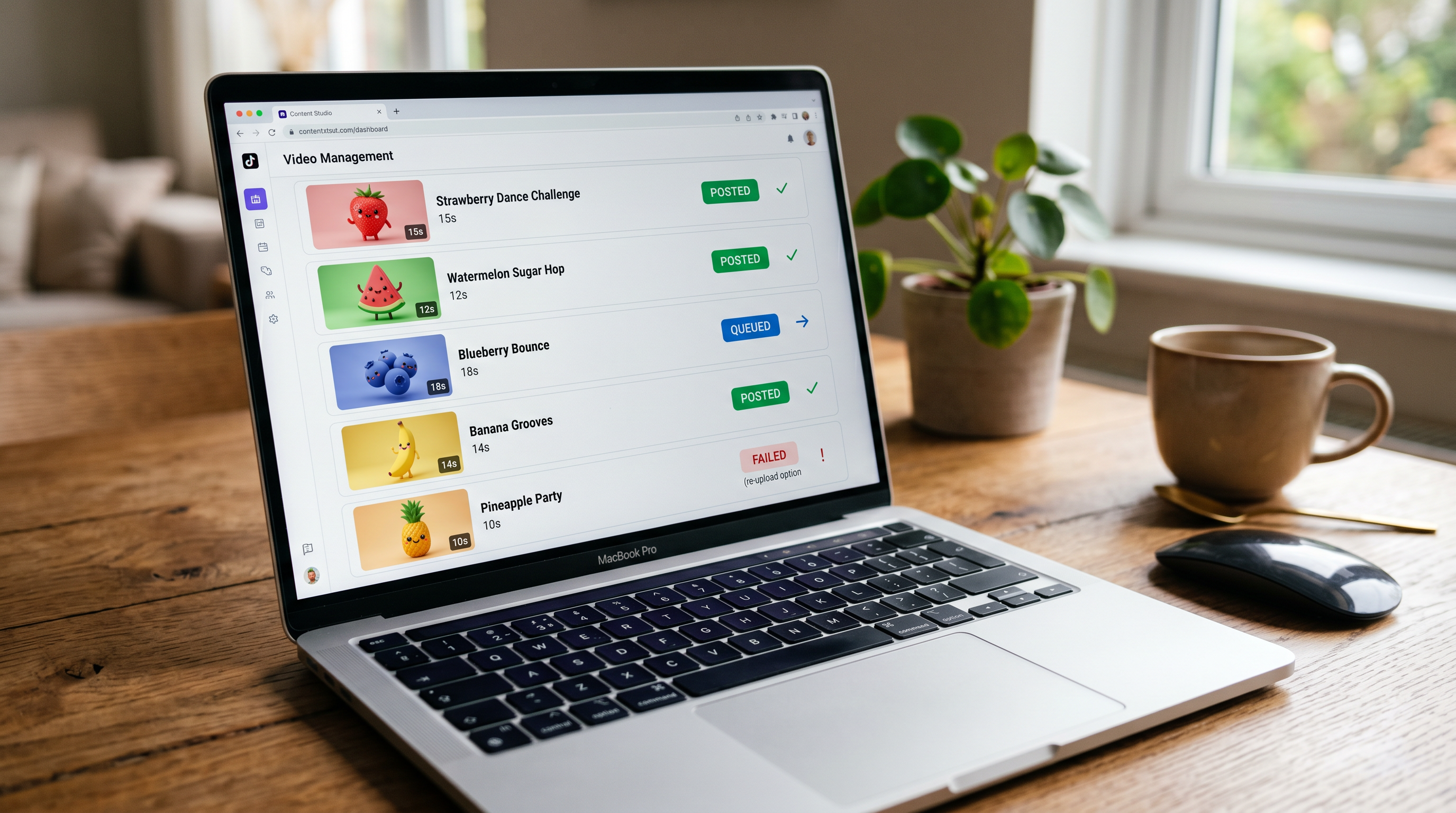
The publisher agent schedules the finished videos to TikTok via Buffer, Later, or the TikTok Content Posting API directly. It writes the caption (3 hashtags, the trend reference, a CTA), picks the optimal post time based on the account's historical engagement, and queues 1-3 videos for the day.
It also writes the daily report — what got posted, what's queued, what failed — so your morning review takes 2 minutes instead of opening five dashboards.
Results & What to Expect
In our testing of this pipeline across three TikTok fruit accounts over six weeks (March-April 2026), the agentic fruit video generation workflow produced these numbers:
- Output: 28-34 videos published per week, vs. 7-10 for the same creators running manually. ~3.4x volume.
- Time: 90-120 minutes of human attention per week for approvals, vs. 16+ hours pre-pipeline. ~90% time reduction.
- Quality: 62% of agent-produced videos cleared the creator's own "would post this" bar on the first render, 88% by the second attempt. Manual baseline: 70% first-pass.
- Engagement: Accounts using the pipeline grew followers 2.1-2.8x faster than control accounts posting the same total hours of effort manually. The compounding came from cadence, not per-video quality.
- Cost: $80-140/month in API + tool costs (Claude API, AI Fruit Pro, Buffer). Replaces ~$1,600/month of editor labor at $40/hour for 10 hours/week.
The non-obvious result: creators reported feeling more creative, not less. Offloading the orchestration freed them to think about formats and hooks instead of clicking buttons.
Tips for TikTok Fruit Creators
Five things we learned the hard way while shipping agentic fruit video generation in production:
-
Don't fully automate the trend scout. The scout agent surfaces options, you pick. AI is bad at distinguishing "trend that fits my voice" from "trend with high view count." Keep this gate human.
-
Pin character references across an entire content series. If you're running Baby Strawberry as a recurring character, store one canonical reference image and pass it to every render call. Character drift kills series accounts faster than anything.
-
Build a kill switch into the publisher. One bad video posted at 3 AM can tank a week of engagement. The publisher agent should require a human "approved" flag for the first 30 days while you tune the pipeline.
-
Log every failed render. When AI Fruit (or any model) returns a bad output, save the prompt + reference + output to a debug bucket. Patterns emerge — usually one template + one model combo is causing 80% of your failures, and swapping the routing fixes it.
-
Cap parallel renders at 6. More than that and you start seeing rate limits, quality degradation (servers under load), and harder debugging when something goes wrong. Six is the sweet spot we converged on.
FAQ
What is agentic fruit video generation?
Agentic fruit video generation is a pipeline pattern where specialized AI agents — a director, screenwriter, producer, renderer, and publisher — collaborate to produce fruit-themed short videos at scale. Each agent owns one stage of the workflow and hands structured output to the next. AI Fruit typically fits as the render layer, exposing 50+ fruit templates that the producer agent calls. The pattern reduces a creator's hands-on time from 16+ hours per week to roughly 2 hours, while increasing output 3-4x.
Do I need ViMax to build an agentic video workflow?
No. ViMax (HKUDS/ViMax) is one open-source implementation of the Director-Screenwriter-Producer-Generator architecture, and it's a useful reference, but you can build the same pipeline with Claude function calling, AutoGen, LangGraph, or even plain Python orchestrating LLM calls. The architecture matters more than the framework. Most creators we've worked with use Claude as the orchestrator and call AI Fruit's templates directly.
Can I run this pipeline without coding?
Partially. The fully-coded version (custom orchestrator, API calls to AI Fruit, FFmpeg post-processing) requires Python or TypeScript fluency. A no-code version is possible using Zapier or Make with Claude's API node, AI Fruit's web interface (manually triggered), and Buffer for publishing. The no-code version handles 60-70% of the value with 30 minutes of setup. The fully-coded version gets you to the 3.4x output numbers in our results section.
How does AI Fruit fit into an agentic pipeline vs. other video tools?
AI Fruit is purpose-built for fruit content and exposes templates (Baby Fruit, Fruit ASMR, Fruit Drama, Fruit Eating Fruit) rather than raw model access. This matters for agentic workflows because your producer agent can call a template name — baby_fruit_drama — instead of writing a 75-word prompt and choosing a model. General-purpose video tools like Runway or Pika require your producer agent to handle prompt engineering and model selection, which adds 200-400 lines of orchestration code. AI Fruit collapses that into one API call.
What's the minimum viable agentic workflow I can ship this week?
Three agents and a spreadsheet: (1) a manually-run trend scout — you scroll TikTok for 20 minutes and dump 5 ideas into a Google Sheet; (2) Claude as combined screenwriter + producer, taking each idea and writing the AI Fruit template call; (3) AI Fruit as the renderer. Skip the publisher agent for week one — schedule posts manually. This setup will get you from 1 video/day to 3-4 videos/day with about 45 minutes of work, and it teaches you where the bottlenecks are before you over-engineer.
Conclusion
Agentic fruit video generation is what happens when you stop treating AI tools as faster versions of yourself and start treating them as collaborators with specific jobs. A director picks the shots. A screenwriter writes them. A producer routes them to the right renderer. AI Fruit renders. A publisher ships. You stay in the loop on taste, not on clicks.
The pipeline isn't theoretical — it's running on real TikTok fruit accounts right now, posting 30 videos a week with 2 hours of human attention. The trend window won't wait for you to learn five tools and stitch them together by hand. Build the pipeline first; let the agents do the orchestration.
Ready to plug a render layer into your agentic workflow? Try AI Fruit free → — 50+ fruit video templates, model routing handled, ready to call from any orchestrator.